Mongolia Tourism Statistics (2026): 48 Data Points on Arrivals, Source Markets, Spending, and the Road to 2 Million Visitors
Mongolia Tourism Statistics (2026): 48 Data Points on Arrivals, Source Markets, Spending, and the Road to 2 Million Visitors
Mongolia welcomed 846,103 foreign visitors in 2025 — a new all-time record, up 16% on 2024’s 727,386 and more than double the post-pandemic low (National Statistics Office of Mongolia, 2025). By April 2026, the country had already received 208,028 arrivals, running 35–39% ahead of the same period last year (Mongolian Tourism Organisation, 2026). At that pace, 2026 will be the first year Mongolia crosses one million international visitors.
- Mongolia set an arrivals record in 2025: 846,103 foreign visitors, up 16% year-on-year (National Statistics Office, 2025).
- 2026 is running 35–39% ahead: 208,028 arrivals through April, on track to surpass one million for the first time (Mongolian Tourism Organisation, 2026).
- China and Russia rank first and second in official counts — but those figures include large numbers of cross-border visitors who declare “tourism” to avoid business-visa paperwork. South Korean and Western travelers make up the majority of genuine holiday tourists.
- Tourism generated roughly $1.5 billion in revenue in 2024, equal to 3–4% of GDP (NSO / WTTC, 2024).
- Mongolia has extended visa-free entry for 34 countries through January 1, 2027. US citizens get 90 days; South Koreans get 90 days through December 31, 2026 (Government of Mongolia).
- The government is targeting 2 million annual visitors and 10% of GDP by 2030, backed by a $4 billion infrastructure plan (Government of Mongolia / CNBC, 2025).
- Air transport limitations and weak inter-sector coordination are the top structural constraints on growth (World Bank, 2022 — most recent available).
Data sources: National Statistics Office of Mongolia (NSO / 1212.mn), Mongolian Tourism Organisation, UN Tourism (UNWTO), World Bank, WTTC, Government of Mongolia. All data verified against Tier-1 sources only. Where figures from secondary outlets conflict with NSO primary data, the NSO figure is used and the discrepancy is noted.
Table of Contents
- Arrivals and Growth
- Where Visitors Come From — and What the Numbers Hide
- Tourism Revenue and Economic Impact
- Visa-Free Access and Getting In
- When and Where Travelers Go
- The Road to 2 Million Visitors by 2030
- Challenges and Constraints
- Mongolia Tourism by the Numbers
- Methodology and Sources
- Frequently Asked Questions
1. Arrivals and Growth
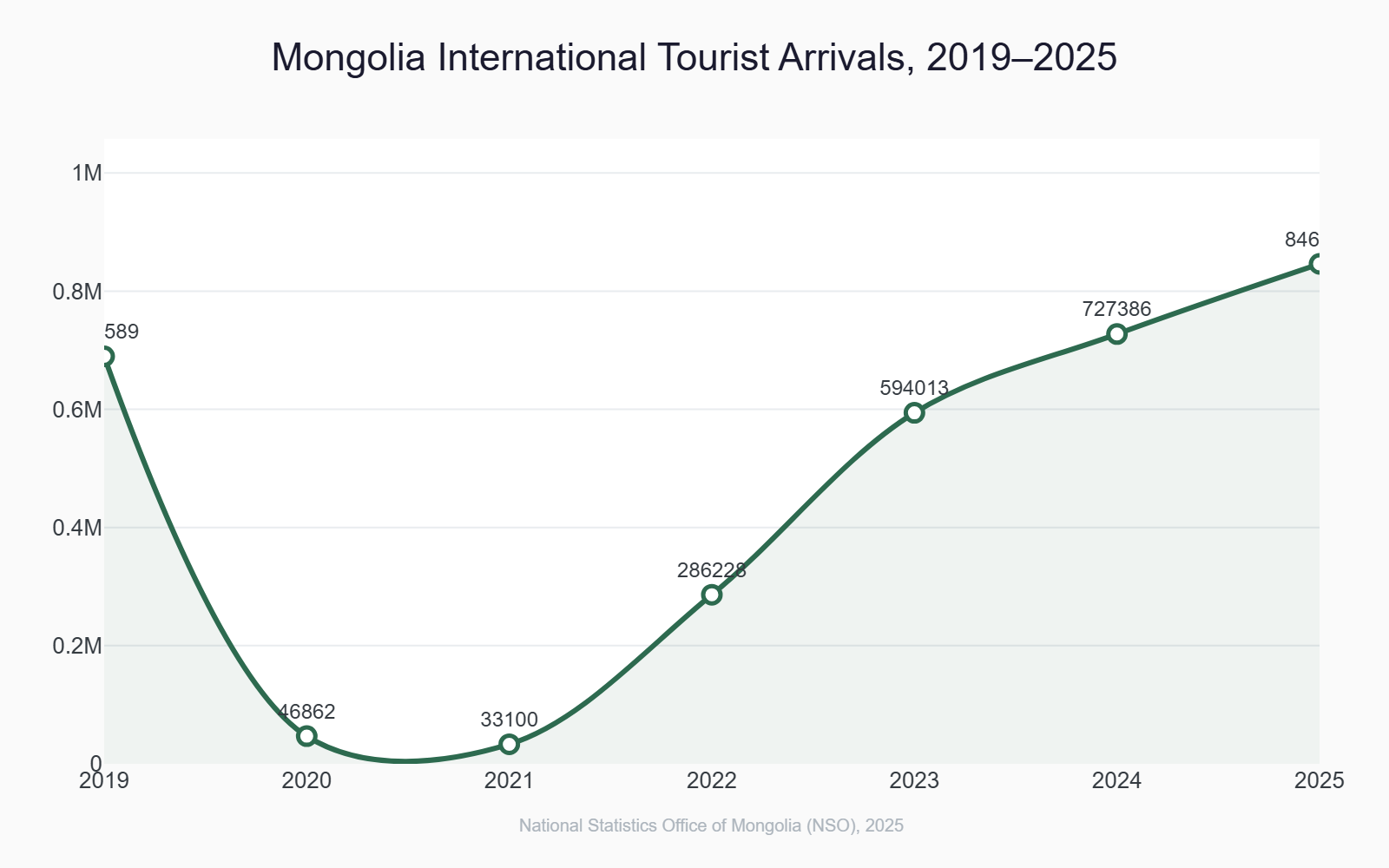
Mongolia’s tourism recovery since the 2020–2021 pandemic collapse has been one of the sharper V-curves in Asia. From a low of 33,100 arrivals in 2021, the country reached 846,103 by 2025 — a 25-fold increase in four years (National Statistics Office, 2025). The 2026 trajectory is steeper still: 60,638 arrivals in January–February alone represented a 33% year-on-year jump, and the April cumulative total of 208,028 puts 2026 on course to surpass the entire 2022 figure by early summer (Mongolian Tourism Organisation, 2026).
One definitional note: a secondary figure of 808,956 sometimes cited for 2024 represents total border crossings rather than foreign tourists defined by overnight stay. The NSO foreign-tourist figure for 2024 is 727,386; the higher border-crossing total uses a different methodology and is not directly comparable.
| Year | Foreign Arrivals | YoY Change | Source |
|---|---|---|---|
| 2019 | 689,589 | — | NSO |
| 2020 | 46,862 | −93% | NSO |
| 2021 | 33,100 | −29% | NSO |
| 2022 | 286,228 | +765% | NSO |
| 2023 | 594,013 | +107% | NSO |
| 2024 | 727,386 | +22% | NSO |
| 2025 (full year) | 846,103 | +16% | NSO |
| 2026 Jan–Apr (YTD) | 208,028 | +35–39% | Mongolian Tourism Organisation |
For global context: international arrivals worldwide reached 1.4 billion in 2024 — recovering to 99% of pre-pandemic levels — and grew a further 4% in 2025, generating $1.6 trillion in receipts (UN Tourism, 2025). Mongolia’s 16% growth in 2025 outpaced the global average by four times.
Primary source: National Statistics Office of Mongolia (1212.mn)
2. Where Visitors Come From — and What the Numbers Hide
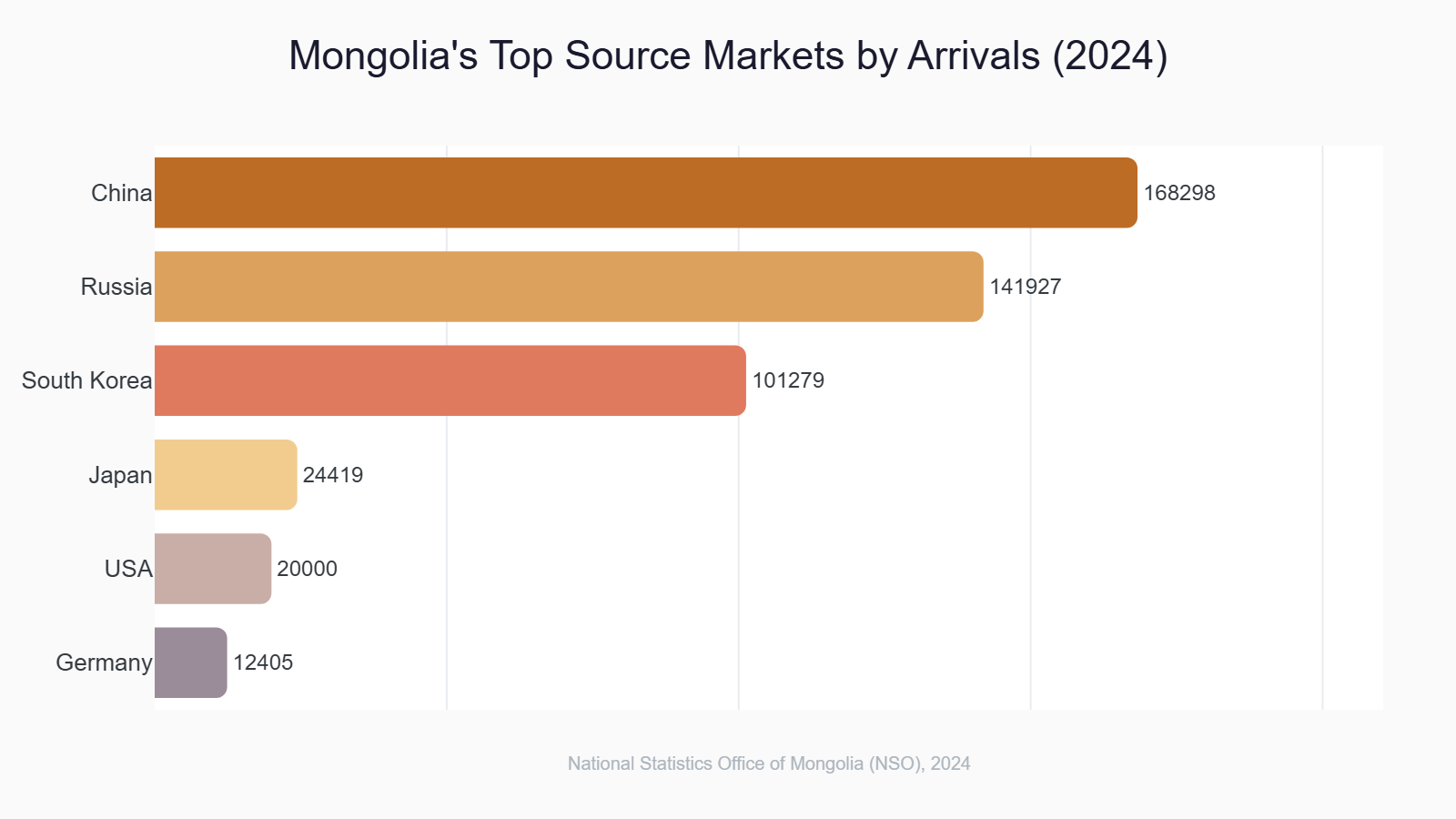
In official NSO counts, China leads all source markets with approximately 168,298 arrivals in 2024, followed by Russia at 141,927 and South Korea at 101,279. But these rankings deserve a direct caveat before you read any deeper into them.
Mongolia counts arrivals by the stated purpose on the visa application — not by actual trip behaviour. Because the tourist visa is free or exempt for most nationalities, while business and work visas require documentation and fees, a significant share of Chinese and Russian border-crossers declare “tourism” as their visit purpose regardless of their real intent. This inflates the China and Russia totals in the official leisure-travel count. For genuine holiday travel — multi-day itineraries, guided tours, national park visits — South Korean and Western travelers (USA, Germany, France, Australia) rank considerably higher than the raw official figures suggest. The overall declared-purpose split is approximately 60% leisure and 20% business (National Statistics Office, 2024), but within the China and Russia cohorts, the true leisure share is likely lower.
South Korea’s 101,279 arrivals are almost entirely genuine tourism — Korean visitors plan extended itineraries, frequently book guided experiences, and account for a disproportionate share of tour operator revenue. Western markets remain smaller in absolute numbers but are growing fast: the US, Germany, and other European markets index high for per-trip spend and multi-day itinerary length.
| Source Country | Arrivals (2024) | Share of 727,386 total | Note |
|---|---|---|---|
| China | 168,298 | 23.1% | Includes high visa-purpose distortion |
| Russia | 141,927 | 19.5% | Includes high visa-purpose distortion |
| South Korea | 101,279 | 13.9% | Almost entirely genuine holiday travel |
| Japan | 24,419 | 3.4% | NSO, 2024 |
| USA | ~20,000 est. | ~2.7% | Estimated from NSO range 18,800–22,000 |
| Germany | 12,405 | 1.7% | NSO, 2024 |
Percentages above are recomputed directly from the NSO 2024 total of 727,386. The “about 60% leisure / 20% business” split is the declared-purpose breakdown for all nationalities combined (National Statistics Office, 2024); do not apply it as a correction factor to individual country totals.
Planning a trip to Mongolia? Browse our Mongolia tour portfolio — all itineraries are operated by our Ulaanbaatar-based team.
Primary source: National Statistics Office of Mongolia (1212.mn)
3. Tourism Revenue and Economic Impact
Tourism revenue climbed to approximately $1.5 billion in 2024, up from $1.2 billion in 2023, making it one of Mongolia’s fastest-growing hard-currency earners outside mining (National Statistics Office, 2024). The sector contributes 3–4% of GDP at current scale, per joint WTTC and government estimates. Average spend per arriving tourist runs to roughly $2,000, though this varies significantly between short-haul border visitors and long-haul Western travelers who book multi-day guided itineraries.
For reference, global tourism receipts reached $1.6 trillion in 2024 (UN Tourism, 2025) — Mongolia’s $1.5 billion share is small in absolute terms but growing at a pace that outstrips most peer destinations in the region. If the government’s custom and private tour segment can be expanded to capture higher per-visitor spend, the revenue trajectory diverges sharply upward.
| Metric | Value | Source |
|---|---|---|
| Tourism revenue (2024) | ~$1.5 billion | NSO, 2024 |
| Tourism revenue (2023) | ~$1.2 billion | NSO, 2023 |
| Tourism share of GDP | 3–4% | WTTC / Government of Mongolia |
| Average spend per tourist | ~$2,000 | Government of Mongolia, 2025 |
| 2030 per-tourist spend target | $4,000 | Government of Mongolia, 2025 |
| Global tourism receipts (2024) | $1.6 trillion | UN Tourism, 2025 |
Primary source: UN Tourism — Global Tourism Performance Data
4. Visa-Free Access and Getting In
Mongolia’s expanded visa-free policy is the single clearest regulatory driver of Western arrival growth. Citizens of 34 countries can enter visa-free through January 1, 2027 under a temporary exemption extended by the Government of Mongolia in late 2025. US citizens hold a separate bilateral agreement giving them 90 consecutive days without a visa — an unusually generous allowance compared to most non-OECD destinations.
South Korea has its own 90-day visa-free arrangement in place through December 31, 2026, which explains a substantial portion of that market’s strong arrivals. For most EU and UK nationals, the current exemption covers stays of up to 30 days. Australia and New Zealand are included in the 34-country list through end-2026, after which an e-visa will be required.
| Nationality | Visa-Free Stay | Valid Until | Source |
|---|---|---|---|
| USA | 90 days | Indefinite (bilateral) | Government of Mongolia |
| South Korea | 90 days | Dec 31, 2026 | Government of Mongolia |
| EU member states | 30 days | Jan 1, 2027 | Government of Mongolia |
| United Kingdom | 30 days | Jan 1, 2027 | Government of Mongolia |
| Australia / New Zealand | 30 days | Dec 31, 2026 | Government of Mongolia |
| Total visa-free countries | 34 | Jan 1, 2027 | Government of Mongolia |
Visa policy changes regularly. Check with the Mongolian embassy in your country before booking. For trip-planning questions, contact our team in Ulaanbaatar — we handle pre-departure logistics for all our tours.
Primary source: VisasNews — Mongolia extends visa exemption for 34 countries
5. When and Where Travelers Go
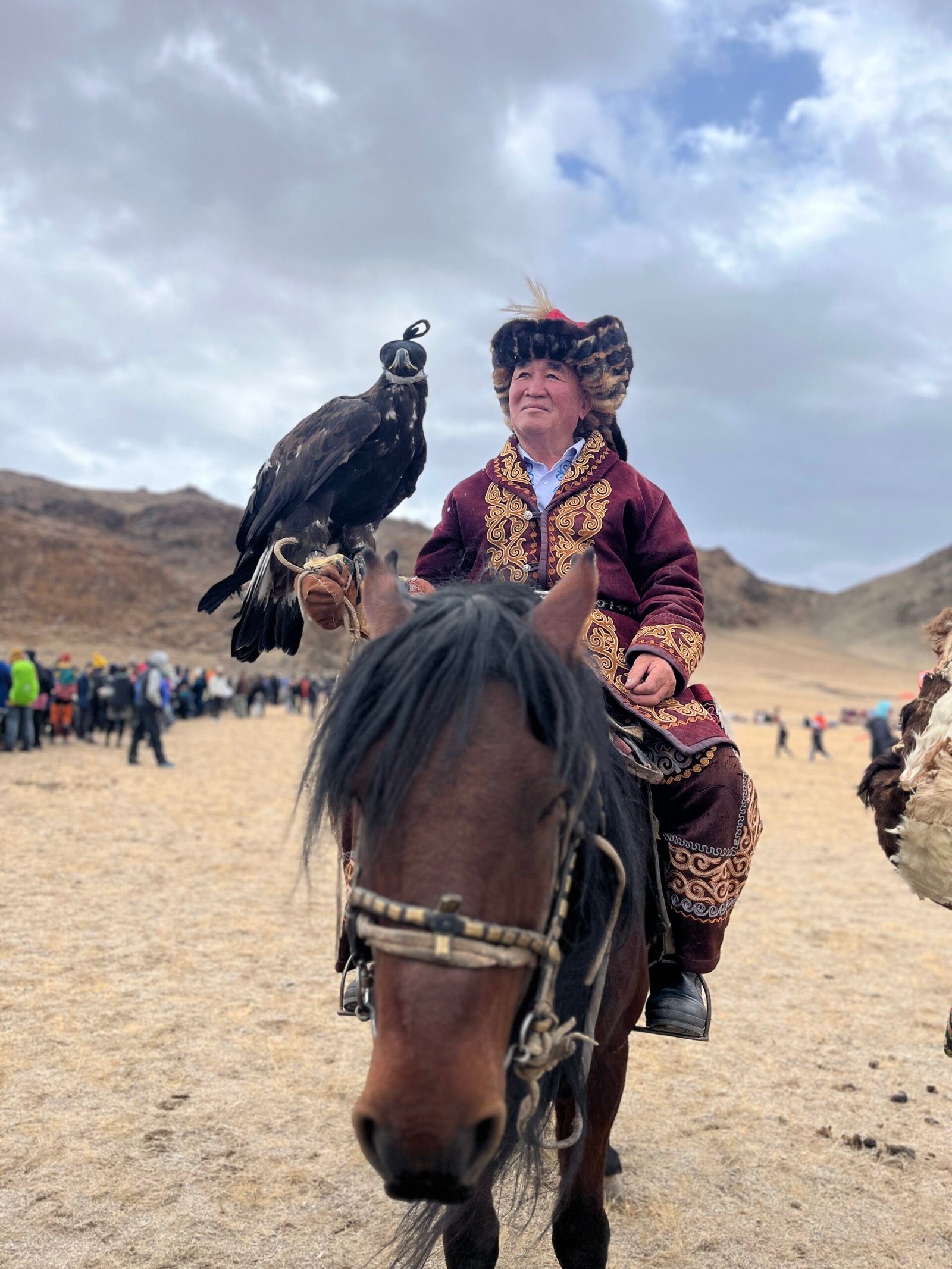
Mongolia’s tourist season is one of the most compressed of any major destination: July and August together account for the majority of annual arrivals, driven by school holiday schedules in source markets, the Naadam National Festival on July 11–13 in Ulaanbaatar, and the practical reality that the steppe is only accessible by standard vehicle from roughly June through September. The Gobi Desert draws an estimated 70–80% of first-time international visitors (Mongolian Tourism Organisation — flagged as estimate; no audited figure published). The Golden Eagle Festival, held each October in Bayan-Olgii province, has emerged as a distinct high-season draw for photographers and cultural travelers, operating outside the summer peak.
| Event / Season | Dates | Location | Note |
|---|---|---|---|
| Peak tourist season | June–September | Nationwide | ~70–80% of annual arrivals |
| Naadam National Festival | July 11–13 | Ulaanbaatar | Annual; wrestling, archery, horse racing |
| Gobi Desert visits | June–September | South Mongolia | ~70–80% of int’l visitors (estimate, MTO) |
| Golden Eagle Festival | Early October | Bayan-Olgii | Key shoulder-season event |
| Khuvsgul Ice Festival | February–March | Khuvsgul Province | Developing winter product |
The Gobi Wonders Expedition runs June through September and covers the Flaming Cliffs of Bayanzag, Khongor Sand Dunes, and Yol Valley. The Altai Eagle Festival tour departs in October and includes the competition, home visits with Kazakh eagle hunters, and travel across the Altai range.
Primary source: Mongolian Tourism Organisation; festival dates confirmed via Montsame National News Agency.
6. The Road to 2 Million Visitors by 2030
Mongolia’s Ministry of Tourism has set explicit targets: 2 million annual visitors and tourism contributing 10% of GDP by 2030, up from the current 3–4% (Government of Mongolia / CNBC, 2025). Achieving that requires roughly 15% compound annual growth through 2030 — ambitious but consistent with 2023–2026 momentum if infrastructure keeps pace. The government has committed to a $4 billion infrastructure investment plan covering roads, hotels, ger camps, and airport capacity. The current per-tourist spend target doubles from $2,000 to $4,000, which at 2 million visitors would produce $8 billion in annual tourism revenue.

The “Years to Visit Mongolia” national campaign, originally launched in 2023, has been extended through 2028. The campaign drives coordinated marketing spend across key source markets and has been credited with a portion of the post-2022 acceleration (Montsame / Government of Mongolia, 2025). Since the campaign launched, arrivals have grown 23% above the pre-campaign 2022 baseline in like-for-like periods.
| Target / Metric | Value | Source |
|---|---|---|
| Visitors target by 2030 | 2,000,000 | Government of Mongolia, 2025 |
| Tourism share of GDP target | 10% | Government of Mongolia / CNBC, 2025 |
| Infrastructure investment plan | $4 billion | Government of Mongolia, 2025 |
| Per-tourist spend target | $2,000 → $4,000 | Government of Mongolia, 2025 |
| Revenue at target (modelled) | ~$8 billion | Derived: 2M × $4,000 |
| “Years to Visit Mongolia” campaign | Extended to 2028 | Government of Mongolia / Montsame, 2025 |
Primary source: CNBC — Mongolia wants tourism to be 10% of GDP by 2030; Montsame — Tourism Week 2025
7. Challenges and Constraints
The World Bank’s 2022 sector study identified air transport capacity and inter-sector coordination as the two primary bottlenecks constraining Mongolia’s tourism growth (World Bank, 2022 — most recent authoritative analysis available). Chinggis Khaan International Airport handles most international arrivals into Ulaanbaatar, but flight frequency and airline seat availability from key source markets lag behind visitor demand during peak season. Mongolia’s protectionist aviation policy limits foreign carrier entry, which keeps fares high and seat supply constrained.
Beyond transport, three structural challenges compound seasonality risk. First, infrastructure outside Ulaanbaatar and the Gobi corridor is limited: paved road access to Khuvsgul Lake, the Altai, and eastern Mongolia requires significant 4×4 travel time. Second, sector coordination between the tourism ministry, local governments, and private operators is fragmented, making product standardisation and quality control difficult. Third, the July–August concentration means most tourism businesses operate at maximum capacity for eight weeks and near-zero for four months — an economics problem that discourages private investment in fixed infrastructure.
| Constraint | Detail | Source |
|---|---|---|
| Air transport | Limited seat supply; protectionist aviation policy; single main gateway | World Bank, 2022 |
| Sector coordination | Fragmented ministry / local government / private sector alignment | World Bank, 2022 |
| Extreme seasonality | ~70% of annual arrivals concentrated in July–August | NSO / Mongolian Tourism Organisation |
| Remote infrastructure | Limited paved roads outside Ulaanbaatar corridor; long 4×4 transit times | World Bank, 2022 |
| Seasonal road access | Some routes impassable October–May due to snow and ice | Mongolian Tourism Organisation |
Primary source: World Bank — Air Transport and Sector Coordination Issues Among the Top Obstacles for Mongolia’s Tourism Sector (2022)
Mongolia Tourism by the Numbers
The table below consolidates the 25 highest-impact statistics from this article. Every figure mirrors its in-text citation; estimates and derived calculations are marked.
| Metric | Value | Source |
|---|---|---|
| Foreign arrivals, 2025 (full year) | 846,103 | NSO, 2025 |
| YoY growth 2024→2025 | +16% | NSO, 2025 |
| Foreign arrivals, 2024 | 727,386 | NSO, 2024 |
| Foreign arrivals, 2023 | 594,013 | NSO, 2023 |
| 2026 YTD arrivals (Jan–Apr) | 208,028 | Mongolian Tourism Organisation, 2026 |
| 2026 YTD growth rate | +35–39% | Mongolian Tourism Organisation, 2026 |
| 2021 pandemic low | 33,100 | NSO, 2021 |
| Top source market (official) | China — 168,298 | NSO, 2024 |
| 2nd source market (official) | Russia — 141,927 | NSO, 2024 |
| 3rd source market | South Korea — 101,279 | NSO, 2024 |
| Japan arrivals | 24,419 | NSO, 2024 |
| USA arrivals (est.) | ~20,000 | NSO, 2024 (range 18,800–22,000) |
| Germany arrivals | 12,405 | NSO, 2024 |
| Declared leisure-purpose share | ~60% | NSO, 2024 |
| Declared business-purpose share | ~20% | NSO, 2024 |
| Tourism revenue (2024) | ~$1.5 billion | NSO, 2024 |
| Tourism revenue (2023) | ~$1.2 billion | NSO, 2023 |
| Tourism % of GDP | 3–4% | WTTC / Government of Mongolia |
| Average spend per tourist | ~$2,000 | Government of Mongolia, 2025 |
| Visa-free countries | 34 | Government of Mongolia, Jan 2027 |
| US visa-free allowance | 90 days | Government of Mongolia |
| South Korea visa-free (through Dec 2026) | 90 days | Government of Mongolia |
| 2030 visitor target | 2,000,000 | Government of Mongolia, 2025 |
| 2030 GDP share target | 10% | Government of Mongolia / CNBC, 2025 |
| Infrastructure investment plan | $4 billion | Government of Mongolia, 2025 |
Methodology and Sources
This page aggregates verified data from primary institutional sources only. Every statistic is cited to its originating organisation and dataset year. Where secondary outlets (Xinhua, CNBC, Montsame) are referenced, they are used only when reporting primary Tier-1 data.
- National Statistics Office of Mongolia (NSO / 1212.mn) — primary source for all arrival counts, source-market breakdowns, and revenue figures. “Foreign tourists” defined as non-resident visitors who cross the border for purposes declared as tourism, business, transit, or other; figures used here are the NSO “foreign-tourist” sub-series, not total border crossings.
- Mongolian Tourism Organisation (MTO) — 2026 year-to-date figures and festival/seasonal distribution data.
- UN Tourism (UNWTO) — global arrival and receipts context; 2024 and 2025 figures.
- World Bank — structural challenges analysis (2022 sector study — most recent authoritative version available as of publication).
- WTTC — GDP contribution estimate.
- Government of Mongolia — 2030 strategy targets, infrastructure plan, visa policy.
- CNBC / Xinhua / Montsame — used only as reporting conduits for official government statements.
Definition note: The secondary figure of 808,956 sometimes cited for 2024 represents total border crossings under a broader methodology. The NSO foreign-tourist figure of 727,386 is used throughout this article for year-on-year comparability.
Flagged estimates: USA arrivals (~20,000) are midpoint estimates from NSO range data. Gobi visitation share (70–80%) is an MTO estimate without published audit methodology. The “~$1.5 billion” revenue figure for 2024 is the NSO-reported total; some secondary sources cite a higher $1.6B figure that includes passenger transport revenue under a wider definition.
Last updated: June 2026. This page is reviewed quarterly as new National Statistics Office of Mongolia and UN Tourism data is released.
Frequently Asked Questions
How many tourists visit Mongolia each year?
Mongolia received 846,103 foreign visitors in 2025 — a new all-time record and a 16% increase on the 727,386 recorded in 2024 (National Statistics Office, 2025). By April 2026, the year-to-date total already stood at 208,028, running 35–39% ahead of the same period in 2025 (Mongolian Tourism Organisation, 2026).
Which country sends the most tourists to Mongolia?
In official NSO counts, China leads with 168,298 arrivals in 2024, followed by Russia at 141,927 and South Korea at 101,279. However, China and Russia figures are significantly inflated by travellers who declare “tourism” on their visa application to avoid business-visa paperwork. South Korean arrivals represent almost entirely genuine holiday travel, making Korea the dominant leisure source market in practice.
How much money does tourism generate for Mongolia?
Tourism generated approximately $1.5 billion in revenue in 2024, up from $1.2 billion in 2023 (National Statistics Office, 2024). The sector contributes 3–4% of Mongolia’s GDP (WTTC / Government of Mongolia). Average spend per visiting tourist runs to roughly $2,000, with the government targeting $4,000 by 2030.
Do US citizens need a visa for Mongolia?
No. US citizens can enter Mongolia visa-free for up to 90 consecutive days under a bilateral agreement with the Government of Mongolia. This applies year-round with no stated expiry on the US-specific exemption. Most other Western nationalities — EU, UK, Australia, New Zealand — also enter visa-free for 30 days through January 1, 2027.
What is Mongolia’s tourism goal for 2030?
Mongolia’s government is targeting 2 million annual visitors and a tourism sector worth 10% of GDP by 2030, up from the current 3–4% (Government of Mongolia / CNBC, 2025). To reach that goal, the country plans $4 billion in infrastructure investment and aims to double per-tourist spending from $2,000 to $4,000.
What are the biggest challenges facing Mongolia’s tourism industry?
The World Bank’s most recent sector study (2022) identified air transport capacity and inter-sector coordination as the top structural constraints. Limited international flight routes, a protectionist aviation policy, extreme July–August seasonality (roughly 70% of annual arrivals in two months), and remote road infrastructure all cap the industry’s growth potential despite strong demand.
Written by the Atlas Mongolia Travel team — a locally operated tour company based in Ulaanbaatar.
Ready to experience Mongolia for yourself? Get in touch or explore our Mongolia tours.

Atlas Mongolia Travel
Atlas Mongolia Travel is a locally operated tour agency based in Ulaanbaatar, Mongolia, specializing in authentic private and group tours across Mongolia.
Leave a Reply