Mongolian Archery at Naadam: How to Read the Bow, the Wall, and the Chant
Mongolian archery is one of the three games of Naadam, alongside wrestling and horse racing. Men and women shoot blunt arrows at a low wall of small leather cylinders set on the ground, knocking them out one by one from a fixed distance. Judges sing a praise chant, the uukhai, each time an arrow lands true.
It looks calm from the stands. It isn’t. Once you know what to watch, the archery field turns into one of the most rewarding hours of the whole festival, slower than the wrestling, quieter than the horse race finish, and full of small rituals that most visitors walk straight past.
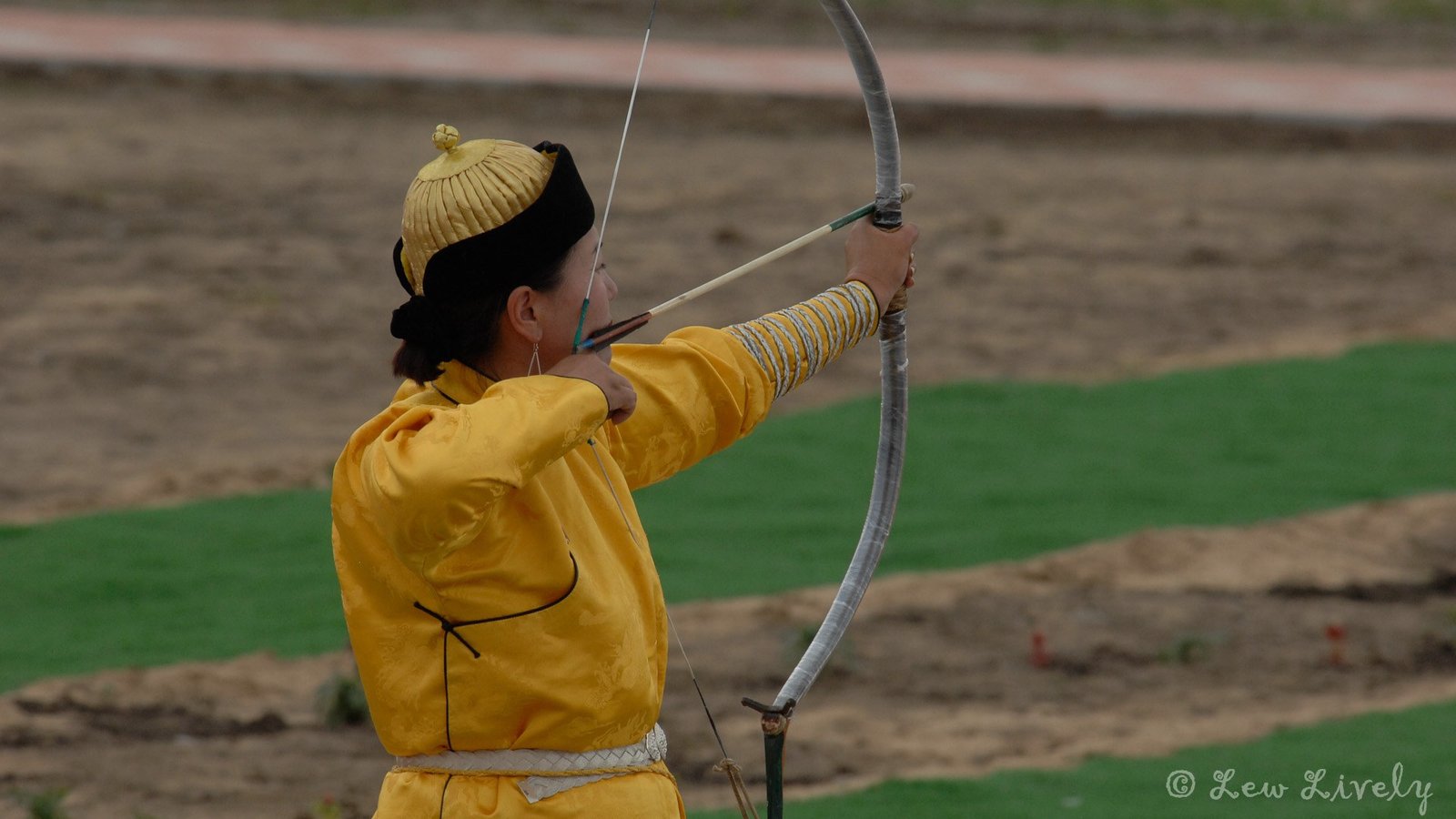
- Naadam archery uses a traditional composite bow of horn, wood, and sinew, not a modern target bow.
- The target is a wall of woven-leather cylinders (*khasaa*) stacked on the ground; archers knock them out from roughly 75 m (men) and 65 m (women).
- The people standing by the targets are the other competitors, not neutral officials. They coach, cheer, and signal where each arrow lands.
- The *uukhai* is a sung praise chant judges raise when an archer scores.
- Ankle-bone shooting (*shagai harvaa*) is the unofficial fourth game and a UNESCO-recognised tradition in its own right.
What you are actually looking at
Set aside everything you know from Olympic archery. There is no paper bullseye, no scoreboard with rings, no archer standing alone in a lane. Naadam archery is a different sport with its own logic.
The target sits on the ground. Competitors build a low wall from small cylindrical targets woven from leather, called khasaa. Each cylinder is roughly the size of a fist, and several dozen are stacked into a wall a few metres wide and only knee-high. The goal is to knock cylinders out of the wall with your arrow. Hits near the centre are worth more than hits at the edges.
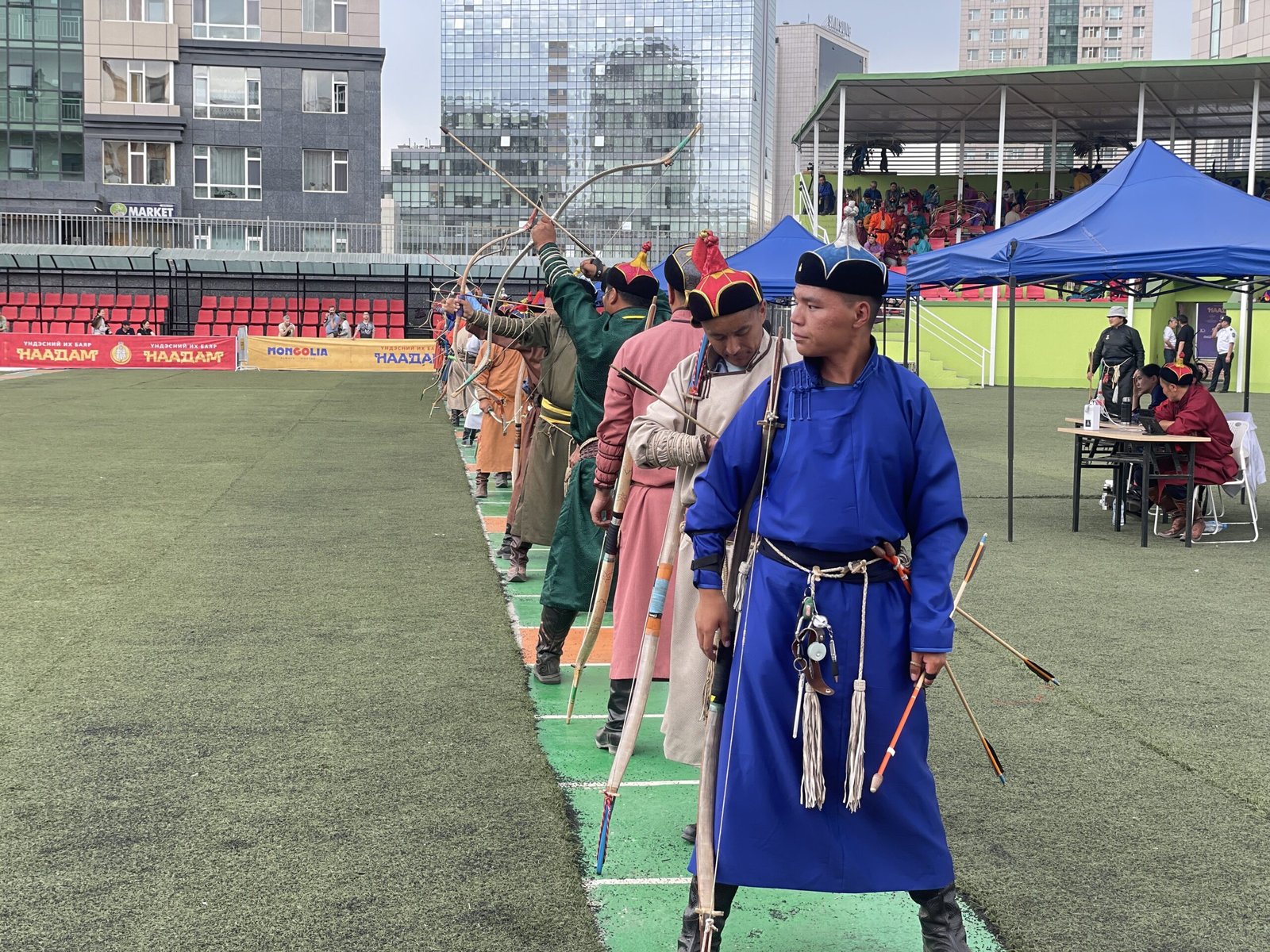
The arrows are blunt, with rounded heads built to push a cylinder loose rather than pierce anything. They fly a flat, fast line and drop into the wall from a distance that surprises most first-time watchers. Men typically shoot from around 75 metres, women from around 65 metres, with each archer loosing a set number of arrows in rounds. The exact distance and arrow count shift between national Naadam in Ulaanbaatar and the smaller countryside festivals, so treat those figures as the standard rather than a fixed rule.
Win at the national level and you earn the title mergen, marksman or markswoman. It is a serious honour, carried for life.
The bow is a year of patience
The thing in the archer’s hand is not a stick with a string. The traditional Mongolian bow is a composite, layered from three materials, each doing a different job.
The belly of the bow, the side facing the archer, is faced with horn, often water buffalo, because horn resists compression and stores energy when the bow bends. The back is laid with sinew, the dried tendon of deer or cattle, beaten into fibres and set in glue, because sinew resists stretching and snaps the limbs forward on release. Between them runs a core of wood or bamboo. The whole thing is bound with fish-bladder glue and finished with birch bark.
That glue is why these bows take so long. The layers have to cure slowly, and a properly made bow can take close to a year to finish. When an archer at Naadam draws back, they are holding a small piece of engineering that predates the Mongol Empire and still outperforms what most people expect from a “traditional” weapon. Many competitors shoot bows passed down through a family or made by a known bowyer, and they will tell you the bow has moods, that it shoots differently in heat, in damp, in wind.
How to actually read the archery
Here is the part the stands miss, and the part our guides love to explain on the field.
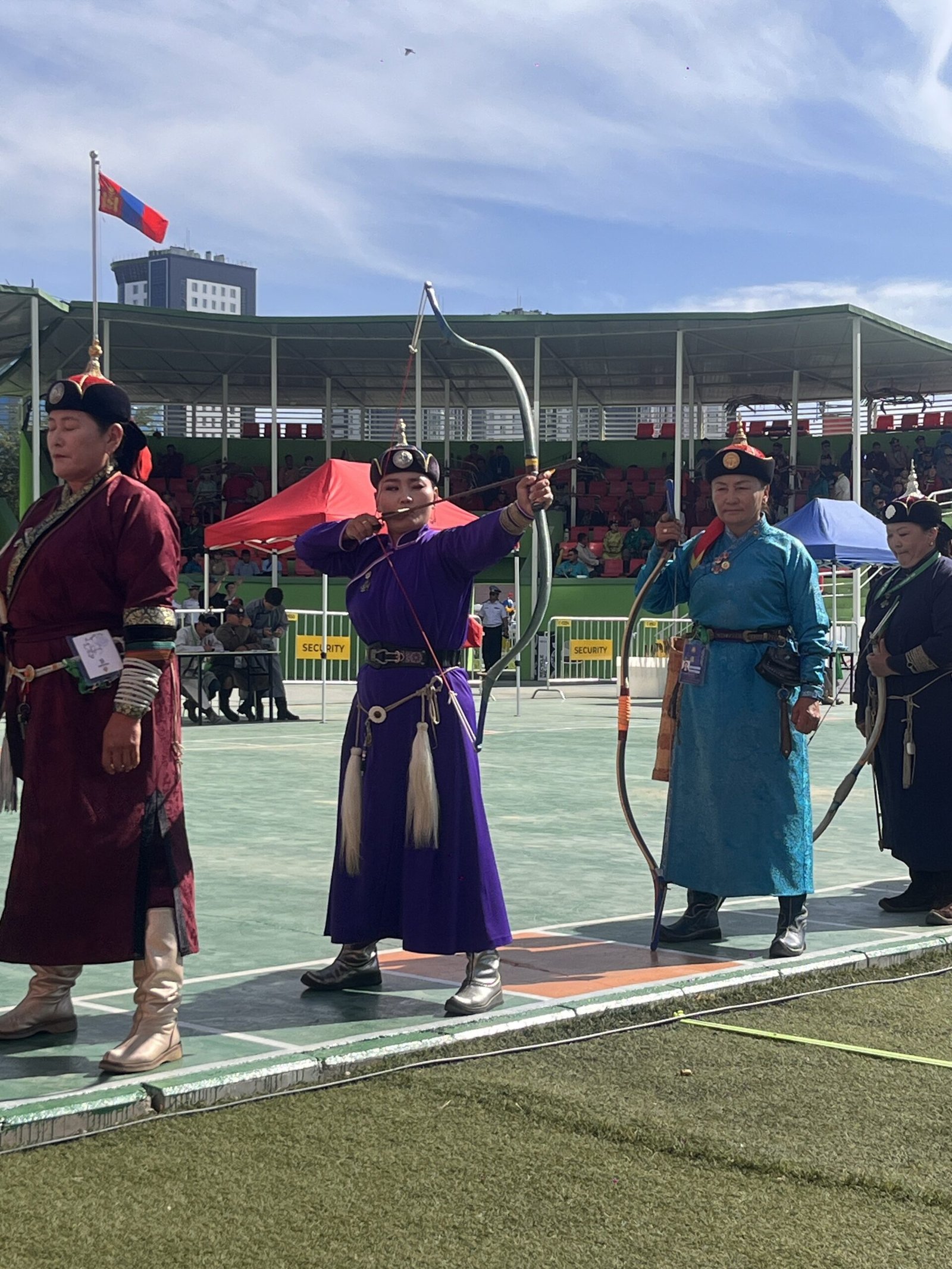
Look at the people standing right beside the target wall. The instinct is to assume they are referees or staff. They are not. They are the other competitors. Archers rotate through the line in groups, and when they are not shooting, they walk down to the targets and stand by the wall, swapping out every round of five arrows. The man who just shot will be standing at the wall a few minutes later while someone else takes aim at the very target he is guarding.
They do three jobs at once. They keep score on the wall. They cheer. And when an arrow lands, they sing.
That song is the uukhai. The judges raise their arms toward the wall, palms up, and sing the long rising praise chant to mark a hit. From a distance it sounds like a single drawn-out note carried across the field, and once you have heard it a few times you start listening for it the way you would listen for a crowd roar at a stadium.
The cleverest part is what happens on a miss. The archer is 75 metres away. They cannot see exactly where a blunt arrow landed in the grass. So the competitors at the wall tell them, with their bodies. They signal whether the arrow fell short, flew long, or drifted left or right, so the next shot can be corrected.
Here is the reading our guides grew up with. Picture the target wall as a person lying down along the ground in front of you. The left end of that body is the legs; the right end is the head. So an arrow that drifts to the left is read as landing toward the legs, and one that drifts to the right as landing toward the head. The competitor at the wall gestures to the part of the body your arrow found, and you ease your aim back toward the centre for the next shot.
They signal distance the same way, showing whether the arrow fell short of the wall or flew long over it, so the archer knows to lift or drop the next one. Watch a single archer through a full round and you start to see the whole conversation, shot, signal, adjustment, better shot. That feedback loop is the craft made visible, and once you can read it, the quiet game becomes the most gripping one to watch.
And watch the archer between shots. The good ones go still. Breath slows. The crowd noise seems to drop away from them. There is a meditative discipline in shooting well in front of thousands of people, holding a draw steady while the wind moves and the uukhai rises somewhere down the line. Archery is the quietest of the three games, and the one that rewards a patient watcher the most.
The fourth game: ankle-bone shooting
Ask most people to name the games of Naadam and they will give you three. Ask a Mongolian and many will add a fourth: shagai harvaa, ankle-bone shooting. It rarely makes the postcards, partly because it happens indoors, out of the sun, in a tent or a hall off to the side of the main grounds.
Step inside and the scene is completely different from the open archery field. Two teams sit in facing rows along a long, polished wooden runway. Each player holds small pieces of bone or horn, shaped and smoothed like little tablets. One at a time, they flick a piece down the slick board with a snap of the finger, sending it skidding several metres to strike a tiny target made of shagai, sheep ankle bones, set up at the far end. Knock the target bones cleanly and you score.
Between shots, the teams sing. It is a low, steady, melodic chant, almost a hum, passed back and forth across the runway. The combination is unforgettable, the dry click of bone on bone, the slide of a piece down the board, and that quiet rolling song underneath it all. It is closer to a ritual than a sport, and it can run for hours.
Ankle-bone shooting was inscribed on UNESCO’s Representative List of the Intangible Cultural Heritage of Humanity in 2014, recognition of how deeply the practice is woven into Mongolian life. The bones themselves carry meaning far beyond this one game. A single shagai has four distinct sides, each associated with an animal, horse, sheep, camel, and goat, and the bones turn up everywhere in Mongolian culture: in children’s games, in tests of skill and luck, and in fortune-telling, where a handful of shagai are cast and read like dice. If you stay with a nomadic family, there is a good chance a small leather pouch of them is somewhere in the ger.
This is the kind of corner our team steers travellers toward. It is quieter, it is harder to find on your own, and it tells you something the main arena cannot.
When and where to watch
National Naadam runs every July in Ulaanbaatar, and the archery and ankle-bone shooting happen at the same grounds as the opening ceremony, away from the wrestling stadium. The countryside Naadams, smaller festivals held in provincial centres around the same period, are often the better experience for archery: fewer crowds, closer access, and a real chance to stand near the line.
For the full overview of how the festival fits together, see our guide to the three games of Naadam. For exact dates, where to sit, and how to plan around the crowds, read our Naadam Festival 2026 insider guide.
Frequently asked questions
What is Mongolian archery at Naadam?
It is one of the three traditional games of Naadam, in which men and women use composite horn-and-sinew bows to knock small woven-leather cylinders out of a low wall set on the ground, shooting from roughly 75 metres (men) and 65 metres (women). It is distinct from Olympic target archery.
What are the targets made of?
They are small cylinders woven from leather, called khasaa, stacked into a wall a few metres wide and about knee-high. Archers aim to knock cylinders out of the wall, with centre hits worth more.
What is the uukhai?
The uukhai is a sung praise chant. When an archer hits the target, the competitors standing by the wall raise their arms and sing it to mark the score. It is one of the defining sounds of the archery field.
Do women compete in Naadam archery?
Yes. Women compete in archery and shoot from a slightly shorter distance than men, around 65 metres compared with roughly 75 metres. Archery is the most open of the three games.
What is ankle-bone shooting (shagai harvaa)?
It is the unofficial fourth game of Naadam, played indoors. Two teams flick small bone or horn pieces down a polished wooden runway to strike a target of sheep ankle bones several metres away, singing a melodic team song between shots. It was recognised by UNESCO as intangible cultural heritage in 2014.
Can I get close to the archery as a visitor?
At national Naadam in Ulaanbaatar the archery grounds are usually more accessible than the wrestling stadium. Countryside Naadams often let you stand much closer. Our guides position you where you can read the signals and hear the chant.
Author: Atlas Mongolia Travel
You can watch Naadam archery from the stands and enjoy it. But the difference between watching and understanding is the difference between seeing a sport and seeing a conversation, the wall, the signal, the adjustment, the chant. That is the kind of thing we put you close to.
If you want to be at Naadam in July 2026, with someone beside you who can read the field as it happens, start planning your trip with us. Tell us what you want to see, and we will build the days around it.
Cultural background on Mongolian archery draws in part on Ts. Oyungerel’s book “Монголоо таниулъя” (Let Me Introduce Mongolia), combined with our team’s firsthand experience on the Naadam field.

Atlas Mongolia Travel
Atlas Mongolia Travel is a locally operated tour agency based in Ulaanbaatar, Mongolia, specializing in authentic private and group tours across Mongolia.

Leave a Reply