The Three Games of Naadam: A Guide to Mongolian Wrestling, Horse Racing, and Archery
The three games of Naadam are wrestling, horse racing, and archery — known in Mongolian as eriin gurvan naadam, “the three games of men.” For two days every July, the whole country stops to watch them. If you understand what’s happening in each one, Naadam turns from a colorful blur into one of the most absorbing things you’ll see in Mongolia.
Most visitors arrive knowing the date and not much else. They watch the wrestling without knowing why a grown man is flapping his arms like a bird, or why a seven-year-old is galloping across open steppe with no saddle. None of it is random. Every gesture carries a few centuries of meaning. Here’s what you’re actually looking at.
- Naadam’s three games are wrestling (*bökh*), horse racing, and archery. Ankle-bone shooting is an unofficial fourth.
- Wrestling has no weight classes and no clock, and wrestlers earn animal titles like Falcon, Elephant, and Lion as they win.
- Horse races are cross-country marathons up to 30 km, ridden by children, judged by the horse’s age, not the jockey’s.
- Archery is shot by men and women at a low wall of small leather targets, with judges singing praise after good shots.
- For dates, locations, and how to attend, see our [Naadam Festival 2026 dates and insider guide](/naadam-festival-2026-dates-insider-guide/).
What “the three games of men” really means
Naadam is Mongolia’s national festival, held every July around the country’s National Day. You’ll find the big one in Ulaanbaatar’s central stadium, but nearly every soum (district) holds its own smaller version on the grass, and those are often the ones worth traveling for.
The three games go back a long way. Wrestling, riding, and shooting were the skills that kept a person alive on the steppe and won battles for the Mongol armies. Over time the training became a contest, and the contest became a festival. Today it’s part sport, part reunion, part national holiday. Picture a county fair, a championship final, and a family wedding all happening on the same field.
A quick note on the name. Eriin gurvan naadam translates as “the three games of men,” but that’s history talking, not today’s rules. Women compete in archery, and the child jockeys in the horse races are both girls and boys. Wrestling remains the one game still reserved for men.
Bökh: Mongolian wrestling
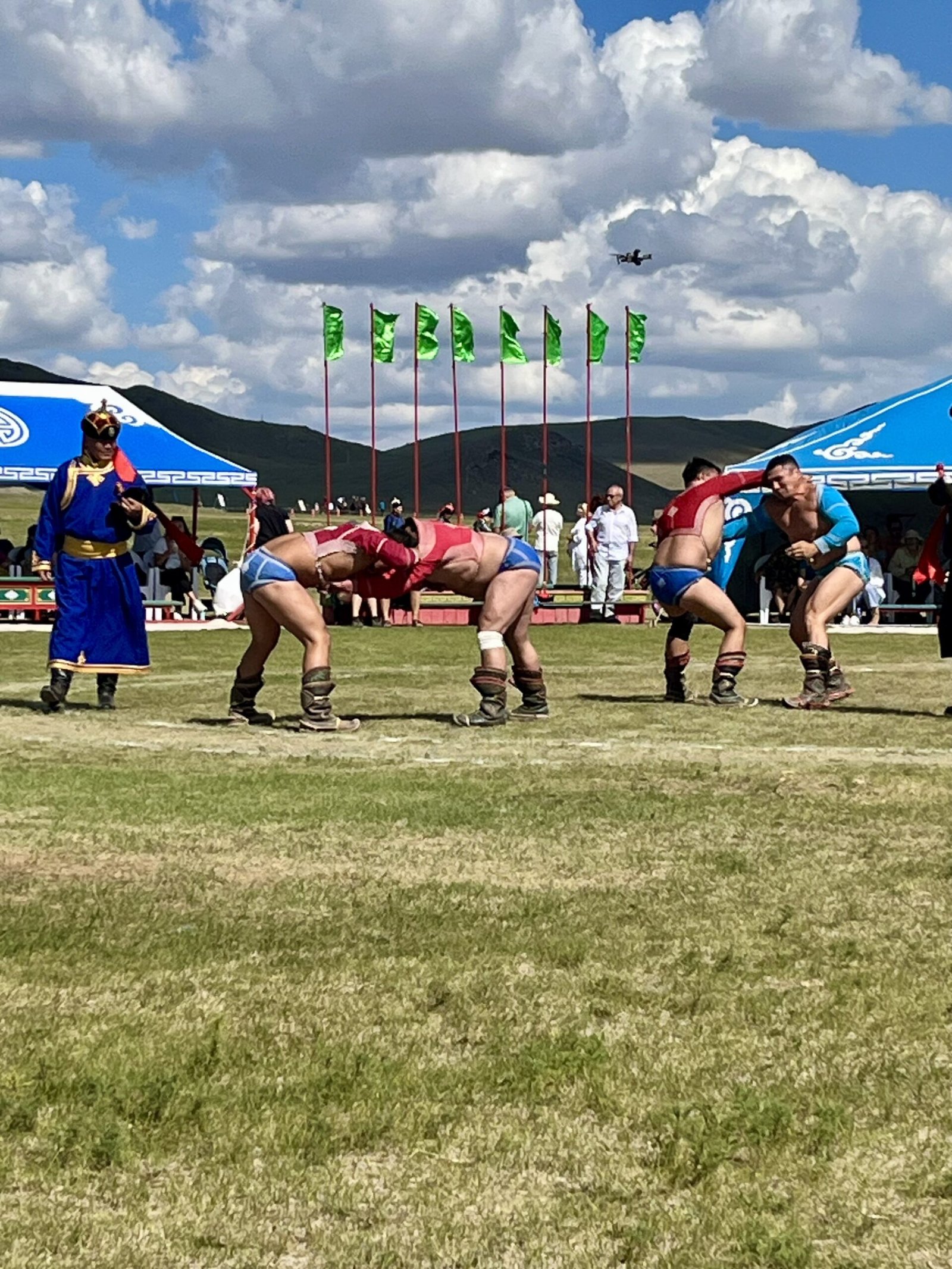
Wrestling is the heart of Naadam, and it’s the game that confuses newcomers the most. There are no weight classes. A wrestler the size of a door can be drawn against someone half his mass in the first round, and often is. There’s no time limit either. A bout can end in fifteen seconds or grind on for twenty minutes while two men lean into each other, reading for the one opening that ends it.
The rule is simple: lose your balance and you lose. If anything above your knee or elbow touches the ground, it’s over. No pins, no points, no second chances. Naadam wrestling is single elimination, so one mistake sends you home.
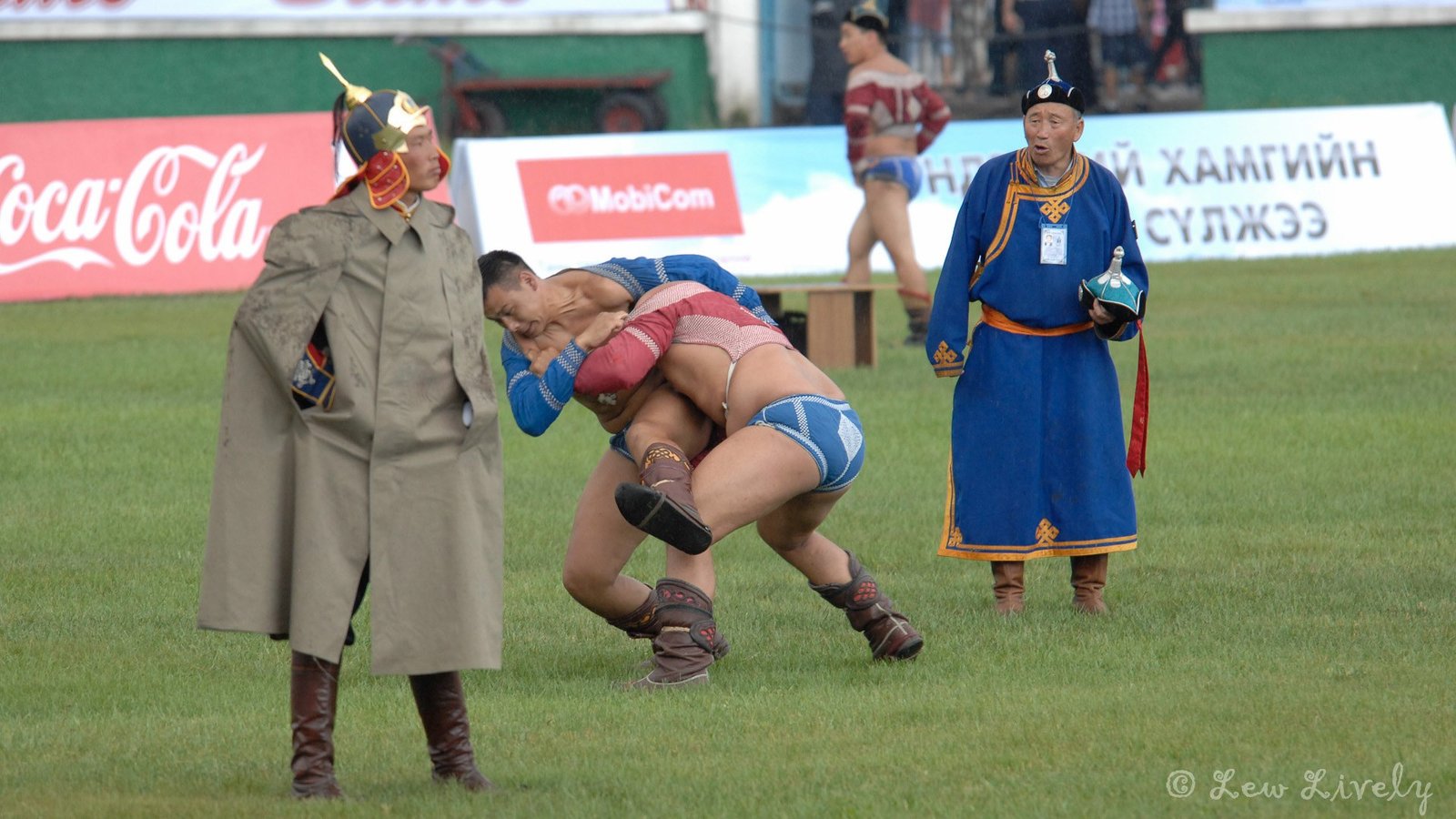
Watch the start of a bout and you’ll see each wrestler stretch his arms and circle, dipping like a bird coming in to land. That’s the eagle dance, devekh. Wrestlers perform it before and after every match, modeled on the Garuda, the mythic bird that crowns Mongolian wrestling’s highest rank. Beside each wrestler stands his zasuul, a kind of second and hype-man rolled into one, who chants the wrestler’s titles to the crowd and slaps him on the back and thighs to fire him up.
Then there’s the outfit. The open-chested jacket (zodog), the small briefs (shuudag), the upturned leather boots. The chest is bare on purpose. The story goes that a woman once entered the wrestling disguised as a man and won, so now the jacket leaves no doubt. Whether that actually happened or just makes a good tale, every Mongolian knows the line.
As wrestlers win round after round, they climb a ladder of animal titles: Falcon for winning the fifth round, Hawk the sixth, Elephant the seventh, Garuda the eighth, and Lion for the man who wins the whole tournament. Win the national title more than once and you become a Titan. Earn a title and it’s yours for life. People will introduce a man as “Lion” decades after his last match.
If you get the chance, skip the stadium and find a soum naadam out in the countryside. The wrestling there is close enough to touch, the grass is your seat, and, as the Mongolian saying goes, a visiting tourist who steps onto the field will probably be folded in half in the first round. (You don’t have to. But the offer tends to come, usually with a grin.)
→ Go deeper: Mongolian wrestling explained — the ranks, rituals, and rules nobody tells you
Horse racing: a children’s marathon across open steppe
Forget the racetrack. Mongolian horse racing is run cross-country, straight over the open steppe, for distances of roughly 12 to 30 kilometers depending on the horses. There’s no rail, no lap — just a thundering line of animals appearing on the horizon and growing larger until the leaders pour across the finish in a wall of dust.
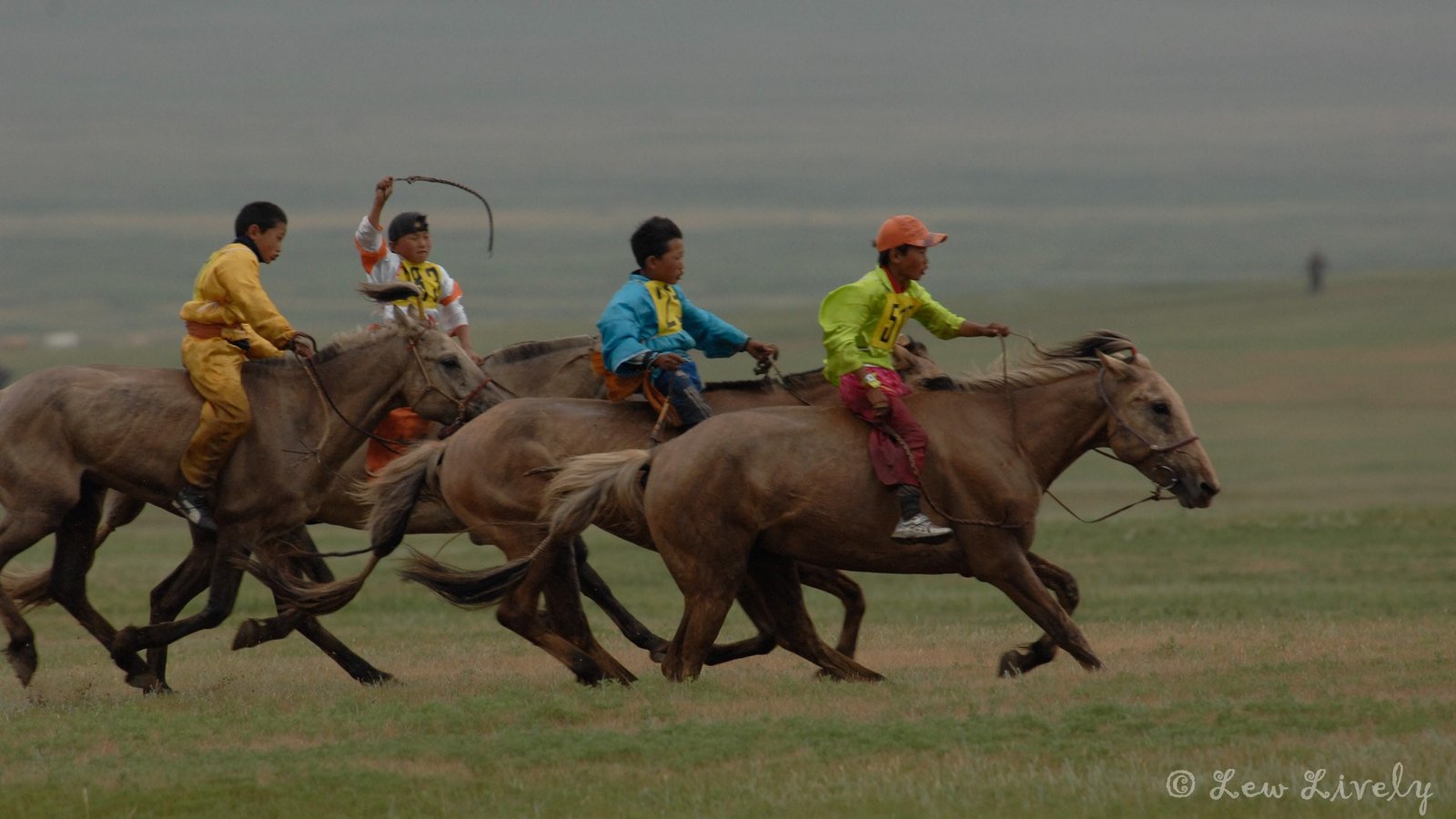
The first thing that surprises people: the jockeys are children, usually between five and thirteen. Mongolians race the horse, not the rider, so the lightest riders are chosen, and many ride bareback. Before the start, the children sing a long, high call to their horses, the giingoo, to settle and steady them for the run ahead.
The races are graded by the horse’s age, not the rider’s. The youngest, two-year-old colts called daaga, run the short course. Three-, four-, and five-year-olds run progressively longer, and the full-grown horses cover the longest ground of all. Stallions race in their own category. Each class has its own race, so a single Naadam can run half a dozen of them across a morning.
When the winner crosses, the crowd doesn’t only cheer the child. The horse is honored too, praised as Tümnii ekh (“leader of ten thousand”), and the top five are celebrated. Then comes the part visitors never expect: the very last horse to finish gets its own song. It’s an affectionate, slightly teasing blessing that wishes the slow horse a place at the front next year. Mongolians don’t laugh the loser off the field. They sing it home.
If watching this stirs something, riding the same kind of horse across the same kind of country is the natural next step. Our Mongolia horseback riding tours put you in the saddle with the herders who raise these animals.
→ Go deeper: Mongolian horse racing at Naadam — child jockeys and the race across the steppe
Archery: stillness as a sport
After the noise of the wrestling and the speed of the races, archery feels like stepping into another room. It’s quiet. It’s slow. And it’s the one game where you’ll watch men and women compete side by side, women shooting from a shorter distance than men.
This isn’t Olympic archery with a bullseye on a stand. The targets are small woven-leather cylinders called khasaa, stacked into a low wall set right on the ground. The goal is to knock them out of the wall from across the field. Standing near the targets are judges in traditional dress who raise their arms and sing a praise chant, the uukhai, each time an archer lands a good shot. The sound carries across the whole ground.
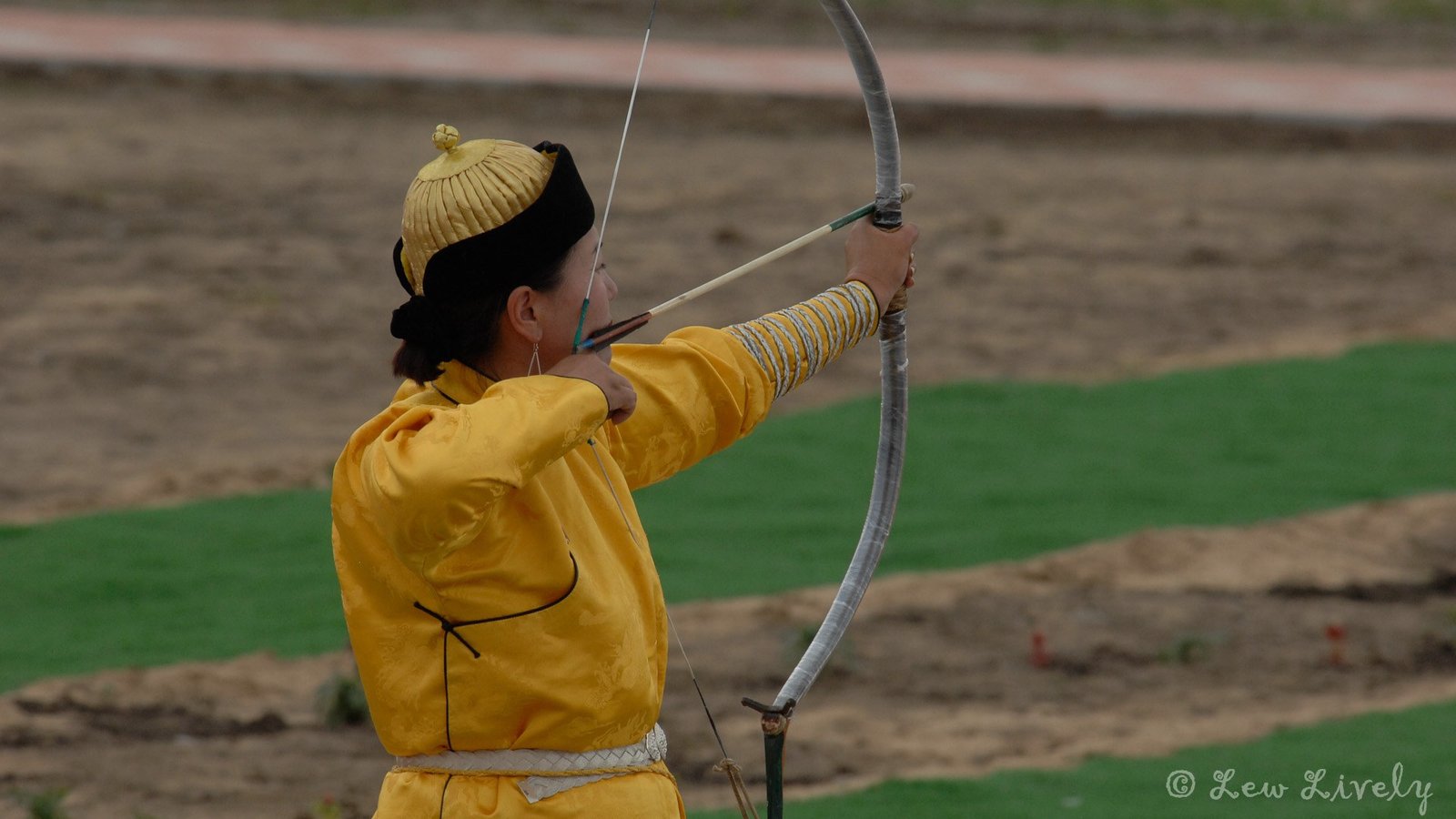
Talk to anyone who shoots and they’ll describe it less as a sport than as a discipline — a matter of breath, balance, and a calm that doesn’t crack under a crowd. The bows themselves are works of patience, traditionally built from layers of horn, wood, and sinew. It’s the game that rewards the watcher who slows down to its pace.
→ Go deeper: Mongolian archery at Naadam — the quiet game, and how to read it
The fourth game: ankle-bone shooting
Ask a Mongolian how many Naadam games there are and some will tell you four. The unofficial fourth is shagai harvaa, ankle-bone shooting, and it’s usually played in a tent or hall just off the main field — worth ducking into.
Teams sit in two facing rows and flick small polished pieces of bone or horn down a smooth wooden runway, aiming to strike target ankle bones set several meters away. It takes a flick that’s equal parts force and precision. The players sing together between shots, a low melodic team song that doubles as concentration and trash talk. It looks gentle and is fiercely competitive. And like the ger and the long song, it’s recognized by UNESCO as part of Mongolia’s living heritage.
→ Go deeper: we cover ankle-bone shooting in full alongside the bow in our Mongolian archery and ankle-bone shooting guide.
How to watch the three games as a traveler
A few things make the difference between watching Naadam and actually following it:
- Pick your venue on purpose. The Ulaanbaatar stadium has the scale and the opening ceremony. A countryside soum naadam has the intimacy — you’ll stand at the rope with the families. If you can, see both.
- Go early for the horse racing. The races are run outside town and often in the morning. Build it into the day rather than hoping to catch it.
- Bring sun cover and water. July on the steppe is bright and shadeless. A hat and sunscreen will save your afternoon.
- Watch the rituals, not just the results. The eagle dance, the giingoo, the uukhai, the song for the last horse — that’s where the meaning lives.
- Mind the etiquette if you’re hosted. Naadam often spills into family gers, and a little courtesy goes a long way. Our guide to ger etiquette covers the basics.
Naadam falls right in the middle of the best stretch of the Mongolian summer, which makes it easy to build into a bigger trip. See when to visit Mongolia for how the season works, or our 7-day Mongolia itinerary for one way to pair the festival with the Gobi and the old capital at Kharkhorin.
Frequently asked questions
What are the three games of Naadam?
The three games are wrestling (bökh), horse racing, and archery, together called eriin gurvan naadam, “the three games of men.” Ankle-bone shooting is often counted as an unofficial fourth.
Why do Mongolian wrestlers have no weight classes?
Traditional wrestling tests skill, balance, and leverage rather than size, so any two wrestlers can be matched regardless of weight. It’s part of why an upset is always possible.
Why are the horse-racing jockeys children?
Mongolian racing judges the horse, not the rider, so the lightest possible riders (children aged roughly five to thirteen) are chosen to let the horse run at its best. Races are graded by the horse’s age.
Can women take part in Naadam?
Yes. Women compete in archery (shooting from a shorter distance) and girls ride in the horse races. Wrestling is the one game still reserved for men.
When and where can I watch the three games?
Naadam is held every July, with the largest event in Ulaanbaatar and smaller versions in towns across the country. For 2026 dates, venues, and tips on attending, see our Naadam Festival 2026 dates and insider guide.
See it for yourself
Read about Naadam and it sounds like a folk festival. Stand at the rope while a two-year-old colt comes out of the dust, or while two wrestlers hold a draw nobody breathes through, and it stops being history. It becomes the loudest, warmest day of the Mongolian year.
We build trips around it — countryside naadam included, where you watch from the grass instead of the grandstand. Tell us what you’re hoping to see and we’ll shape a route around the festival and the summer around it.
Cultural detail in this guide draws on Ts. Oyungerel’s book “Монголоо таниулъя” (Let Me Introduce Mongolia), alongside our team’s own experience at Naadam. Terms and traditions are described as Mongolians use them.

Atlas Mongolia Travel
Atlas Mongolia Travel is a locally operated tour agency based in Ulaanbaatar, Mongolia, specializing in authentic private and group tours across Mongolia.

Leave a Reply