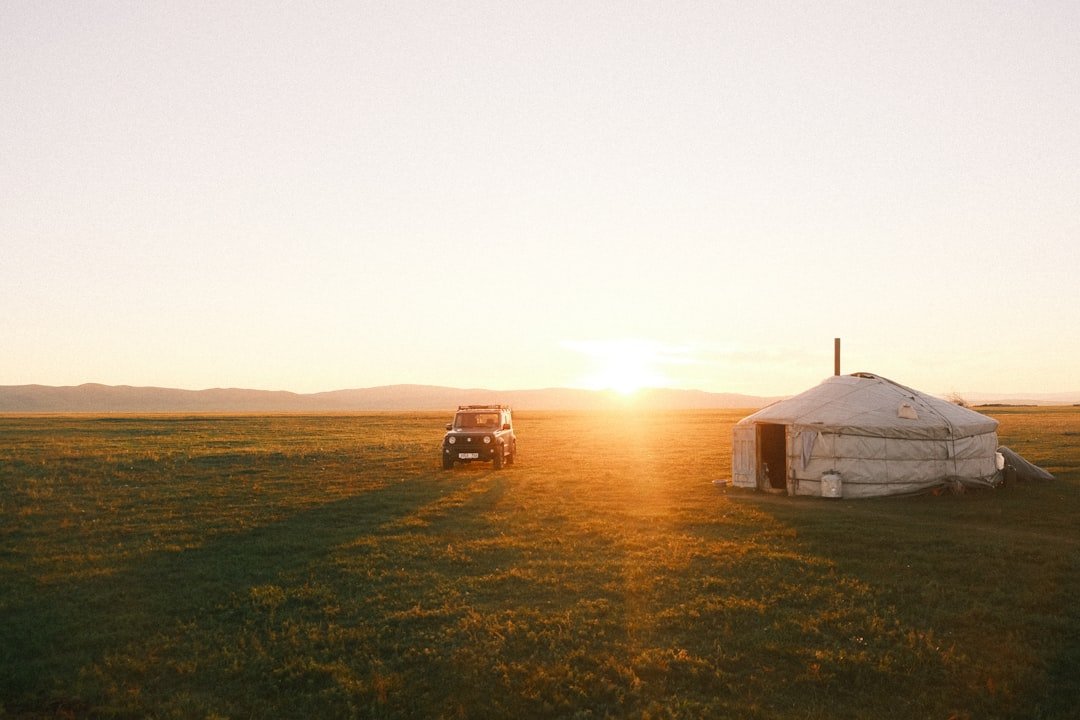
Best Time to Visit Mongolia: A Local Guide to Every Season, Month by Month
Mongolia doesn’t have a bad season — it has seasons with different characters. Summer puts you in the steppe when it’s green and alive, with the Naadam Festival at its peak. Autumn strips the crowds away and turns the northern forests gold. Spring brings newborn animals and open roads. Even winter has its loyalists: frozen lakes, eagle hunters, and skies so clear they feel invented.
The question isn’t whether Mongolia is worth visiting at a given time of year. It’s which Mongolia you want to experience. This guide walks through every month so you can match your trip to your priorities — whether that’s festivals, photography, nomadic culture, specific regions, or simply the most comfortable weather.
- Peak season (June–August) offers the best weather and the Naadam Festival, but with the highest prices and crowds
- September is the best month for photography — golden light, autumn colours, and fewer visitors than summer
- May is the best-value month: near-peak conditions at shoulder-season prices, with spring wildlife and open roads
- Eagle Festival travelers should target September over October — milder weather and smaller crowds
- Mongolia records 257 sunny days per year — one of the highest in Asia
- The Gobi Desert and the northern lake region behave very differently month-to-month — plan by region, not just by season
Table of Contents
- Mongolia’s Four Seasons at a Glance
- Spring: March to May
- Summer: June to August
- Autumn: September to October
- Winter: November to February
- Best Month by Travel Type
- Regional Differences to Know
- Planning Your Mongolia Trip
Mongolia’s Four Seasons at a Glance
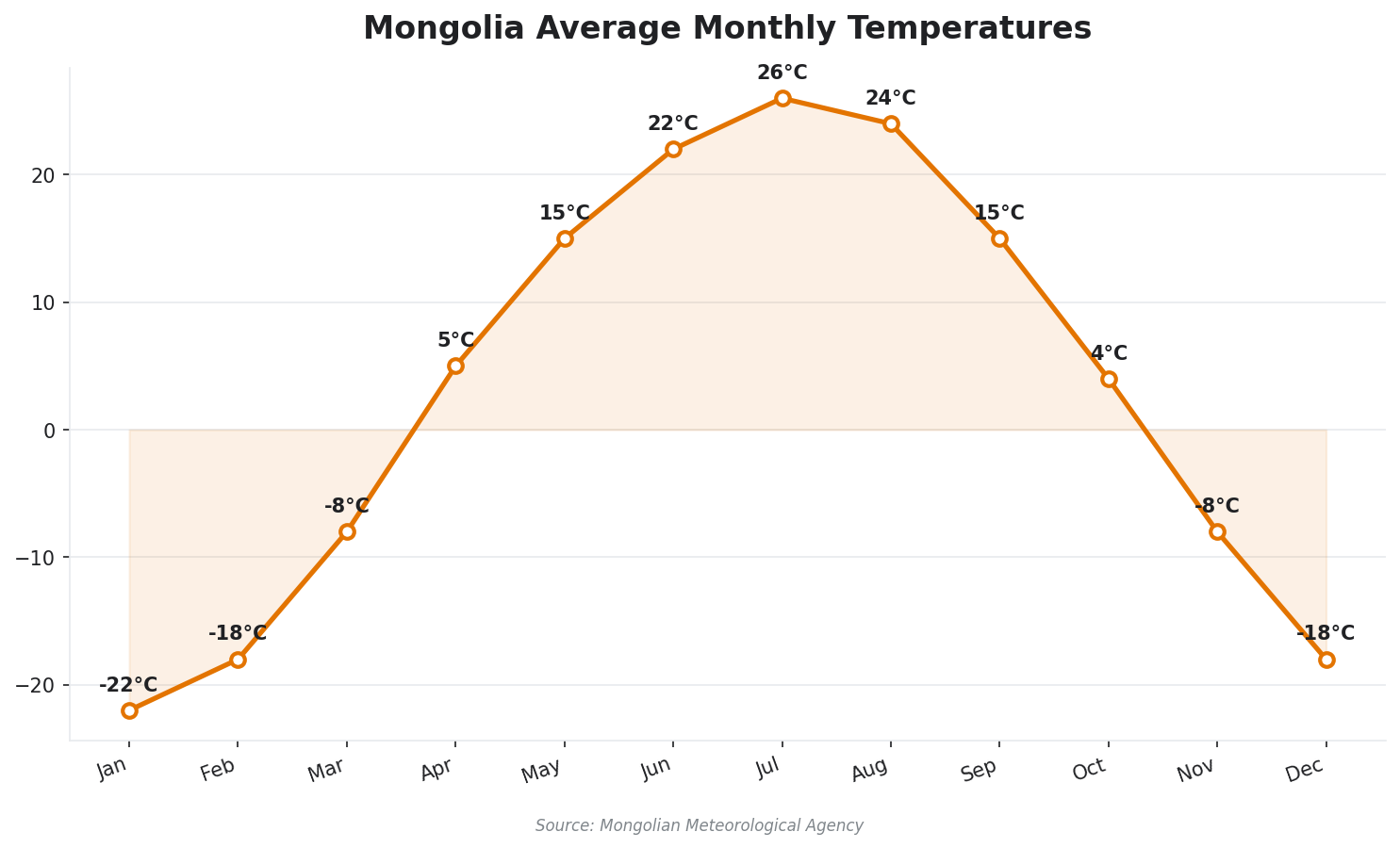
Mongolia sits at an average elevation of around 1,580 metres above sea level on the Central Asian plateau (World Bank country data), which explains why its climate swings harder than most countries at similar latitudes. The continental climate means long, cold, dry winters and short summers that pack a full season of warmth into three or four months. Mongolia records 257 sunny days per year — more than most of Europe — but that sunshine in January comes with temperatures that can drop to -35°C.
The travel season runs roughly May through October. Within that window, the peak is June through August. Outside it, travel is possible but requires experience, the right operator, and a genuine appetite for cold.
Spring: March to May
March — Festivals in the Cold
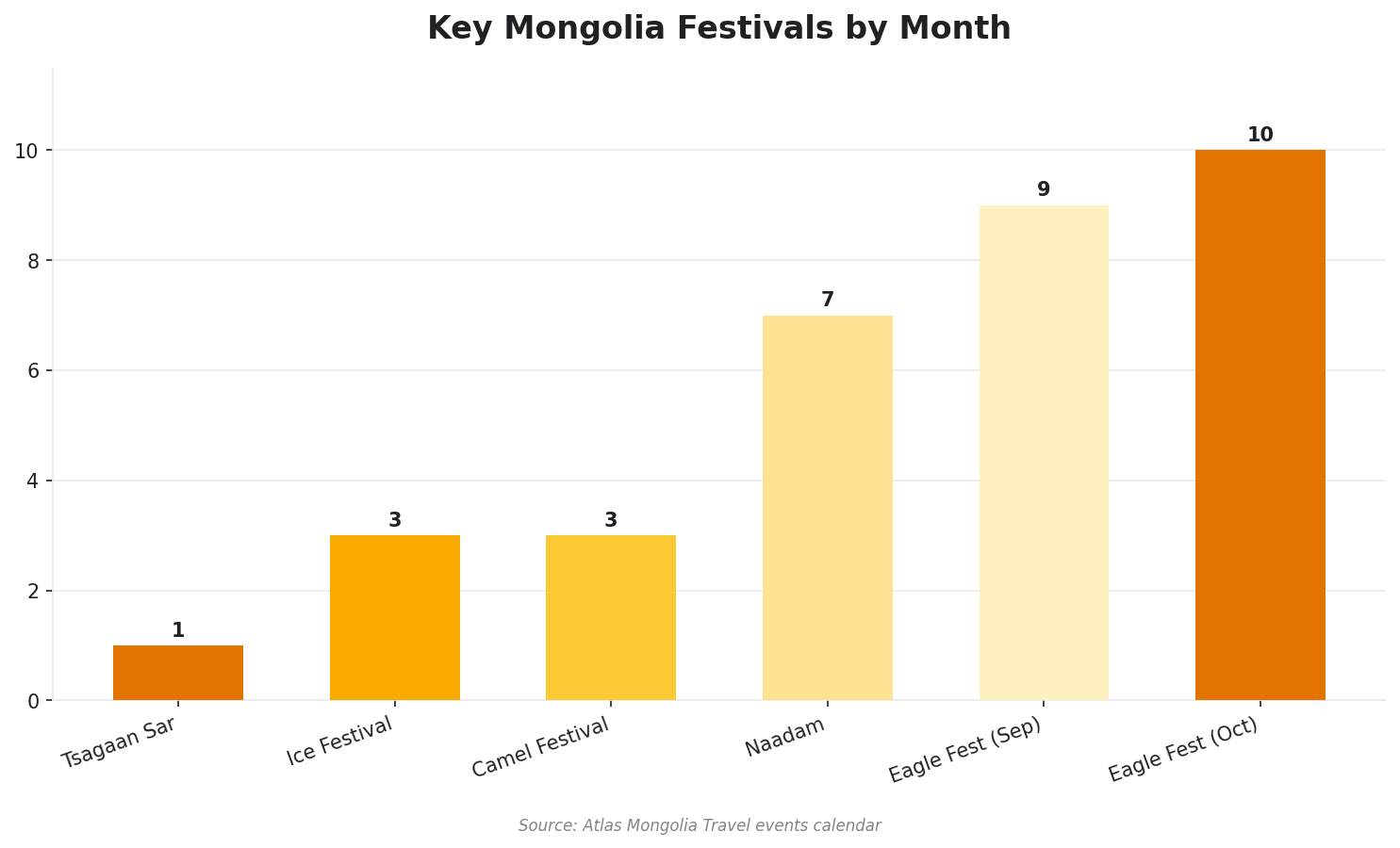
March is the cusp. The country is still frozen — northern regions see temperatures as low as -15°C, the steppe hovers around -8°C to +5°C — but the calendar starts waking up. Three events make March worthwhile for the right traveler:
- Khovsgol Ice Festival — held on the frozen surface of Lake Khovsgol in northern Mongolia. Ice sculptures, reindeer sleds, and shamanic ceremonies on one of the world’s clearest lakes.
- Thousand Camel Festival — Bulgan town in the South Gobi province celebrates Mongolia’s Bactrian camel herders with races, polo on camelback, and cultural demonstrations.
- Eagle Festival near Ulaanbaatar — a smaller version of the famous October festival, held closer to the capital.
If you’re drawn to Mongolia’s winter cultural life rather than its landscapes, March is your entry point. Ger camps in the countryside are still closed; accommodation is in local guesthouses and family homestays, which means more genuine contact with Mongolian daily life.
April — The Steppe Wakes Up
April temperatures climb to an average maximum of 8°C on the central steppe, with wildflowers beginning to push through the thawing ground. Nomadic families are moving their gers and livestock from winter to summer pastures — one of the most visually distinctive things you can witness in Mongolia, and rarely seen by tourists because most arrive in summer when the migration is complete.
The winds in April are significant. Dust storms are common in the Gobi Desert, and the steppe can feel raw. But the landscape — still winter-pale, with herds moving across it — has a beauty that summer, with its green polish, doesn’t replicate.
May — The Best-Value Month
May is the most underrated month in Mongolia. By the second half of the month, temperatures reach 17–28°C in the daytime; nights are still cool but manageable. The steppe is turning green, tourist camps in northern and western Mongolia are just reopening, and the crowds that define July haven’t arrived.
The Gobi Desert in May is particularly good — temperatures are warm but not yet brutal (daytime averages 13°C), and the spring wildlife is active: newborn Bactrian camels, foals, and lambs are everywhere on the steppe. Nomad families welcome visitors during the spring birthing season with a genuine warmth that’s harder to find in peak summer when tourism traffic is higher. Our guides make a point of stopping when we pass families with their herds — helping water animals at a well, lending a hand with milking, greeting people the Mongolian way. In May, those encounters happen naturally, because the countryside is quiet and people have time.
Prices are lower than summer across the board.
Summer: June to August
June — Peak Conditions, Pre-Crowd
June is our favourite month to run tours, and most of our guides will tell you the same. The steppe has fully greened, daytime temperatures average 22°C with lows around 8–10°C at night. The air is clear, the light is extraordinary, and the Naadam celebrations haven’t yet begun — so you’re travelling in summer conditions without July’s tourist density.
Smaller regional Naadam festivals take place throughout June across rural provinces. These local events — a wrestling competition in a village, horse races across the open steppe, archery beside a river — are often more memorable than the main Ulaanbaatar event precisely because they’re not staged for visitors.
The Gobi Desert hits 35°C in June. If your itinerary includes the south, focus on early mornings and late afternoons — our drivers know the timing well enough to get you to the Flaming Cliffs right as the light turns gold, not three hours early staring at flat sun.
July — Naadam Season
July is peak season, and Naadam is the reason. Mongolia’s national festival — held officially on 11–13 July in Ulaanbaatar, with provincial celebrations running through the first half of the month — is one of the great cultural events in Asia. UNESCO added Naadam to its Intangible Cultural Heritage list in 2010. Three traditional sports: horse racing (ridden by children across 15–30 km of open steppe), wrestling (no weight classes, no time limits), and archery (in traditional dress, using composite bows). The atmosphere in Ulaanbaatar during Naadam is unlike anything else Mongolia offers.
July is also the hottest month. The Gobi reaches 38–40°C midday. The steppe averages 26°C. Rainfall increases — Ulaanbaatar sees around 69mm in July, often as intense afternoon downpours that pass quickly. The days are long: 15+ hours of daylight.
The trade-off for peak conditions is peak crowds and peak prices. Book accommodation, tours, and internal flights months in advance if you’re targeting Naadam week.
August — Summer’s Second Act
The first half of August is essentially an extension of July — warm, green, active. After Naadam, domestic tourism peaks as Mongolian families take summer leave. The second half shifts noticeably: daytime temperatures ease to 20–22°C, nights cool to 8–10°C, and the light takes on the first hints of the golden quality that defines September.
August is excellent for the mountain regions — Altai in the west, Khangai in the centre, Khentii in the east — where trekking and horse-riding conditions are ideal. Lake Khovsgol in the north is at its most accessible and swimmable. The Orkhon Valley Yak Festival and Reindeer Festival at Khovsgol also fall in this window.
Autumn: September to October
September — The Photographer’s Month
September is the month most experienced Mongolia travelers return to. The tourist crowds have thinned. The light is extraordinary — the low autumn sun at high altitude creates a warmth and depth to the landscape that July’s overhead sun can’t match. The steppe turns from summer green to gold, the forests of the north shift through amber and red, and the air carries a clarity that makes the mountains look closer than they are.
Daytime temperatures run 15–25°C; nights drop below 0°C, especially in the north and at altitude. Pack accordingly — Mongolia at any time of year requires layering, but September’s range makes it non-negotiable.
Nomadic families in September are in their autumn routines: livestock are fat after summer grazing, dairy production is at its richest, and winter preparations give daily life a purpose and rhythm that’s compelling to witness. This is one of the best months for genuine nomadic family stays.
The Golden Eagle Festival in Western Mongolia takes place in late September and early October. The September timing is generally preferable: milder temperatures, smaller crowds, and more time with the eagle hunters rather than being one of hundreds of visitors watching a performance.
October — Quiet Season, Golden Gobi
October is the last month before Mongolia closes down for winter. Daytime temperatures drop to 4–12°C; nights go below freezing across the country. Tourist camps close on 5 October, which shifts accommodation to local guesthouses and family homes — exactly the kind of travel some visitors specifically seek.
The Gobi Desert in October is one of its finest moments: the summer heat is gone, the light is soft and golden, and you’ll have the Flaming Cliffs and Khongoryn Els almost to yourself. The Golden Eagle Festival (October edition) draws larger crowds than September’s but is easier to reach for travelers with fixed departure dates.
Winter: November to February
Mongolia’s winter is not a casual undertaking. November temperatures drop to -17°C to -25°C at night; January, the coldest month, can reach -35°C or lower on the steppe. Ger camps outside national parks near Ulaanbaatar are closed. Roads in remote areas can be impassable after heavy snow.
And yet: Mongolian winter has its own distinct character that no other season replicates. The steppe under deep snow, the frozen rivers and waterfalls of the north, the herders navigating -30°C on horseback — this is Mongolia as most of the world never sees it.
Tsagaan Sar, the Mongolian Lunar New Year, falls in January or February. It is the most important family festival in the Mongolian calendar, and spending it with a local family — the exchange of snuff bottles, the three days of visiting, the tables of traditional food — is one of the most culturally immersive experiences available anywhere in Central Asia.
Winter travel requires an experienced operator, the right cold-weather gear, and realistic expectations about comfort. It’s not for everyone. For those it suits, it’s unforgettable.
Best Month by Travel Type
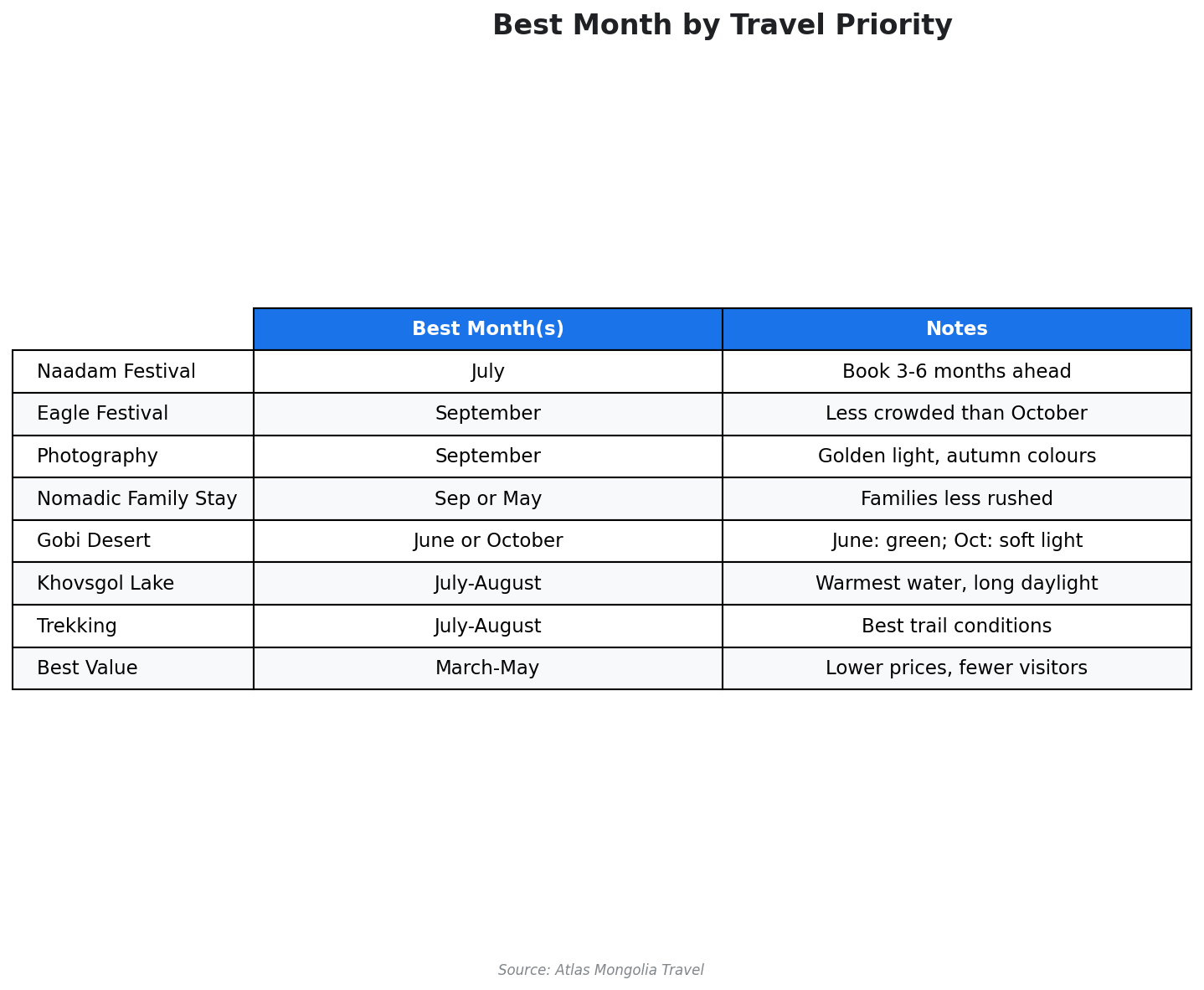
| Priority | Best Month(s) | Notes |
|---|---|---|
| Naadam Festival | July | Book 3–6 months ahead for peak week |
| Eagle Festival | September | Less crowded than October; milder weather |
| Photography | September | Golden light, autumn colours, clear air |
| Nomadic family stay | September or May | Families less rushed than in peak summer |
| Gobi Desert | June or October | June: green steppe; October: soft light, no crowds |
| Khövsgöl Lake | July–August | Warmest water; long daylight hours |
| Trekking & mountains | July–August | Best trail conditions |
| Best value | March–May | Lower prices, fewer visitors |
Regional Differences to Know
Mongolia is large — nearly three times the size of France (CIA World Factbook) — and its regions behave differently in the same month.
Gobi Desert (south): warmer than the rest of Mongolia year-round. Summer is brutal midday; spring and autumn are ideal. May and October are the Gobi’s best-kept secrets.
Central steppe and Ulaanbaatar: the standard reference for temperature guides. Naadam country. Most accessible by road year-round.
Northern Mongolia and Khövsgöl Lake: cooler and wetter than the south. Summer (July–August) is the window. Spectacular autumn colour in September. The Taiga and Tsaatan reindeer herders are best reached September through early October.
Western Mongolia (Altai region): home to the Kazakh eagle hunters. Best in September–October for the Eagle Festival. Summer trekking in Altai Tavan Bogd National Park is world-class.
Frequently Asked Questions
What is the best month to visit Mongolia?
For most first-time visitors, July is the peak month — warm weather, the Naadam Festival (July 11–13), and long daylight hours. If you want fewer crowds and exceptional photography light, September is consistently rated the best overall month by experienced Mongolia travelers. May offers excellent value: near-summer conditions with shoulder-season prices.
When should I avoid visiting Mongolia?
November through March is challenging for most travelers. January temperatures on the steppe can reach -35°C, most ger camps outside Ulaanbaatar close, and remote roads can be impassable after heavy snow. Spring (late March–April) brings dust storms and strong winds, particularly in the Gobi. That said, winter travel is not impossible — it requires the right operator and a genuine appetite for extreme cold.
Is Mongolia safe to visit as a solo traveler?
Yes. Mongolia has low crime rates relative to most international destinations. The main challenges for solo travelers are logistical: remote areas require vehicles and local knowledge, and the language barrier outside Ulaanbaatar is significant. Most solo travelers pair with a local guide for countryside travel, which also opens doors to nomadic family visits that are otherwise difficult to arrange.
How far in advance should I book a Mongolia trip?
For Naadam season (July), book 3–6 months ahead — ger camps, internal flights, and good tour packages sell out. For other months, 6–8 weeks is generally sufficient, though private customised tours benefit from more lead time. For the Eagle Festival in October, book at least 2–3 months ahead as it has a small capacity window.
Can I visit Mongolia independently without a guide?
Ulaanbaatar is straightforward to explore independently. Countryside travel is a different matter: there are no paved roads across most of Mongolia, no road signs in remote areas, and a breakdown can be a serious situation without local support. Most independent travelers rent a vehicle with a driver-guide, which solves both the navigation and the local access problem simultaneously.
What is the weather like in Mongolia in summer?
Summer (June–August) is warm and generally dry. Daytime temperatures on the central steppe average 22–26°C, though the Gobi Desert can push to 38–40°C in July. Nights are cool (8–12°C), even in peak summer — pack a layer. Rainfall increases in July, mostly as short afternoon downpours that pass quickly. Daylight runs to 15+ hours.
When you know your timing, the next step is choosing the right tour. Browse all Atlas Mongolia Travel tours or read about the Naadam Festival 2026 if you are considering a July trip.
Planning Your Mongolia Trip
Mongolia rewards the traveler who matches their timing to what they actually want to see. The difference between arriving in early June and mid-July isn’t just temperature — it’s a completely different experience of the country.
Atlas Mongolia Travel runs private tours across every season, not just summer. If you’re weighing between September and October, wondering whether to catch Naadam or skip the crowds, or trying to combine the Eagle Festival with the Gobi into one itinerary — those are exactly the conversations our team has with travelers every day.
Our founder Tuguldur’s rule: every traveler is different. Two guests can start with the same itinerary and end up with completely different trips, because once we understand what someone actually cares about — whether that’s photography, horsemanship, food, or just silence — we adapt. The itinerary is a starting point, not a script. You can also read our practical guide to payments in Mongolia to start getting ready for the trip.
Every trip is private, customised, and built around when you want to go and what matters to you.
Ready to plan your Mongolia trip? Get in touch for a free, no-obligation consultation →
Featured image: Photo by Manduul Amar on Unsplash

Atlas Mongolia Travel
Atlas Mongolia Travel is a locally operated tour agency based in Ulaanbaatar, Mongolia, specializing in authentic private and group tours across Mongolia.
Pingback: Mongolia Visa Requirements 2026: What Every International Traveler Needs to Know