Golden Eagle Festival Statistics (2026): 35+ Facts on Mongolia’s Kazakh Eagle Hunters and Their Birds
Golden Eagle Festival Statistics (2026): 35+ Facts on Mongolia’s Kazakh Eagle Hunters and Their Birds
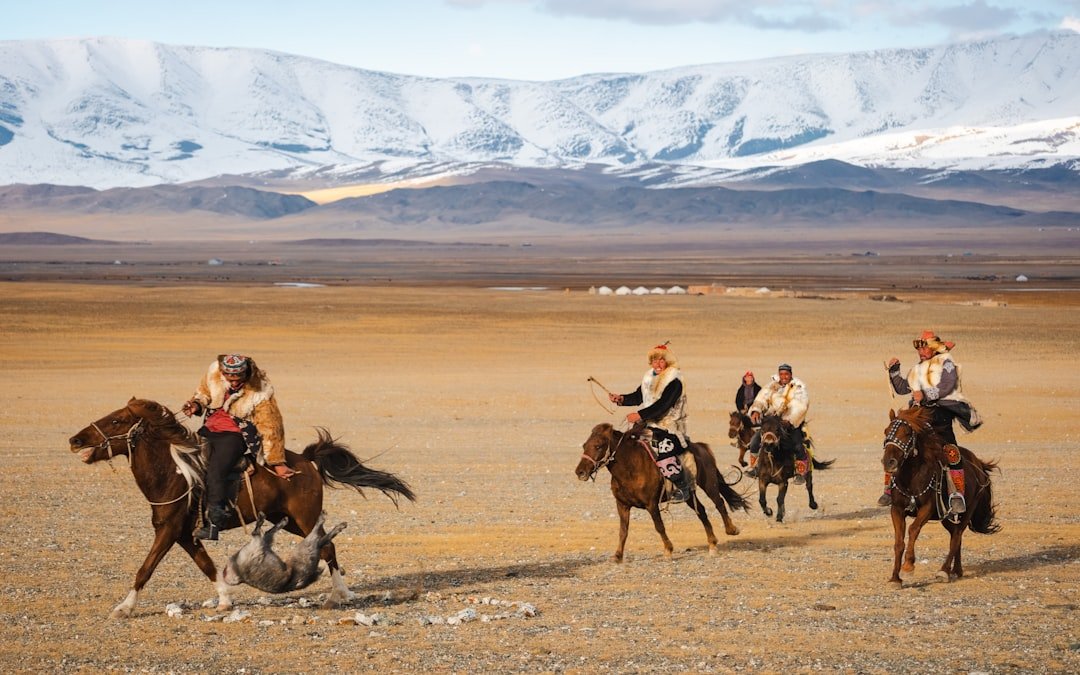
The Golden Eagle Festival is held annually in Bayan-Ölgii Province, far-western Mongolia. The main October edition in Ulgii drew more than 60 eagle hunters and around 700 visitors in 2025 (Mongolian Eagle Hunters’ Association, 2025). A smaller September edition runs in Sagsai, a village 20 km from Ulgii, with roughly 40 hunters competing. The tradition behind the festival — Kazakh falconry — has been recognized on UNESCO’s Representative List of the Intangible Cultural Heritage of Humanity since 2010.
- The 2025 Ulgii festival drew 60+ eagle hunters and ~700 visitors; 2026 dates fall in early October
- Approximately 400 registered eagle hunters (burkitshi) are active in Mongolia today
- Female golden eagles are used exclusively — they weigh up to 6.4 kg and reach dive speeds near 200 mph
- Bayan-Ölgii Province is ~90% Kazakh — the only Muslim-majority aimag in Mongolia
- UNESCO inscribed falconry as intangible cultural heritage in 2010; Mongolia was a co-nominating nation
- Hunters traditionally release their eagle back to the wild after 7–10 years of partnership
Table of Contents
1. The Festival — Dates, Scale, and Format
2. The Eagle Hunters (Burkitshi) — Who They Are
3. The Eagle Huntresses — A Changing Tradition
4. The Golden Eagles — Biology and Performance Data
5. Bayan-Ölgii and the Kazakh Community
6. UNESCO Recognition and Cultural Preservation
7. The Golden Eagle Festival by the Numbers — Master Reference Table
1. The Festival — Dates, Scale, and Format
The main Golden Eagle Festival takes place in the first weekend of October each year, on the open steppe about 4 km outside Ulgii town in Bayan-Ölgii Province. The 2025 edition ran October 4–5 and drew more than 60 eagle hunters and approximately 700 visitors (Mongolian Eagle Hunters’ Association, 2025). That 700-visitor figure reflects a festival that has grown substantially since its founding — attendance in the early years numbered in the dozens.
The festival was founded in 2000 through a collaboration between local Kazakh eagle hunters and two tour operators who wanted to create a platform for preserving the tradition (Wikipedia, Golden Eagle Festival). Some sources date the inaugural event to 1999; the most-cited founding year is 2000. A second, smaller edition was established in 2002 in Sagsai, a village roughly 20 km from Ulgii, and runs each September with around 40 hunters competing.
| Metric | Value | Source |
|---|---|---|
| 2025 festival dates (Ulgii) | October 4–5 | Mongolian Eagle Hunters’ Association, 2025 |
| 2025 eagle hunters (Ulgii) | 60+ | Mongolian Eagle Hunters’ Association, 2025 |
| 2025 visitors (Ulgii) | ~700 | Press / Mongolian Eagle Hunters’ Association, 2025 |
| Distance from Ulgii town | ~4 km (steppe venue) | Nomadic Expeditions, 2025 |
| Sagsai festival founding year | 2002 | Wikipedia, Golden Eagle Festival |
| Sagsai hunter participation | ~40 | Responsible Travel, 2024 |
| Ulgii festival founding year | ~2000 | Wikipedia, Golden Eagle Festival |
| Up to hunters (peak Ulgii) | ~80 | Nomadic Trails, 2024 (estimate) |
The festival schedule includes two competition days. Day one opens with a horseback parade of hunters in embroidered Kazakh dress, followed by games of Tenge Ilu (picking up a coin at full gallop), Kiz Kuar (a mock chase between riders), and Kukbar (a mounted tug-of-war over a goat carcass). The main hunting competitions — speed and accuracy of the eagle’s descent to the lure — run across both days.
For anyone considering attendance, Atlas Mongolia Travel runs a dedicated Altai Eagle Festival tour that pairs the festival days with private time in Kazakh hunter camps in the surrounding Altai valleys.
2. The Eagle Hunters (Burkitshi) — Who They Are
The Kazakh word burkitshi (бүркітші) means eagle hunter. It is an inherited identity as much as a skill — training begins in childhood, typically watching a father or grandfather work with their bird, then progressing to handling, conditioning, and eventually capturing a wild eaglet. Approximately 400 burkitshi are currently registered with the Mongolian Eagle Hunters’ Association, though the actual number of active practitioners is estimated between 250 and 400 depending on how activity is measured (Mongolian Eagle Hunters’ Association, via multiple press reports, 2023–2025).
The tradition nearly collapsed during the Soviet-era collectivization of the 1930s–1960s, when nomadic lifestyles were heavily disrupted across Mongolia. The post-1990 democratic transition allowed a cultural revival, and hunter numbers have grown since. Ethnographic fieldwork published in the 2010s documented the resurgence as younger Kazakhs reconnected with ancestral practices (Al Jazeera, 2023).
| Metric | Value | Source |
|---|---|---|
| Registered eagle hunters (Mongolia) | ~400 | Mongolian Eagle Hunters’ Association (est.) |
| Active practitioners (range) | 250–400 | Multiple press reports, 2023–2025 (estimate) |
| Primary location | Bayan-Ölgii Province | NSO Mongolia |
| Tradition age | 2,000+ years (claimed) | UNESCO / ethnographic literature |
| Training start age | Childhood (typically 8–14) | Ethnographic literature / Al Jazeera, 2023 |
| Years hunter keeps eagle before release | 7–10 years | Ethnographic sources / View Mongolia |
| Eagle returned to wild? | Yes — traditional practice | Multiple documented sources |
The release practice is worth dwelling on. After 7–10 years of partnership, a burkitshi returns the eagle to the wild — releasing it during late summer so it can find a mate before winter. A female eagle who has spent a decade hunting in partnership with a human hunter is then expected to survive and breed in the wild. Hunters typically capture a new eaglet to begin the cycle again.
3. The Eagle Huntresses — A Changing Tradition
Eagle hunting was historically a male practice, transmitted father to son through Kazakh lineage. Female participation has been documented and debated — Al Jazeera’s 2023 longform investigation counted approximately 11 eagle huntresses actively practicing in Mongolia, a number consistent with earlier estimates of 10–11 (Al Jazeera, 2023; View Mongolia, 2024). The figure is small relative to 400 registered male hunters, but it is growing.
The figure most associated with this shift is Aisholpan Nurgaiv, born in 2000 in Bayan-Ölgii Province. She began following her father on hunting trips at age 10, captured her own eaglet, and competed at the 2014 Golden Eagle Festival in Ulgii at age 13 — winning first place and becoming the first girl to place at the top of the competition (Girl Museum, 2024; Asia Society, 2017). Israeli photographer Asher Svidensky’s photographs of Aisholpan went viral in 2014, and British director Otto Bell’s documentary The Eagle Huntress (2016) — narrated by Daisy Ridley — brought the story to international audiences.
| Metric | Value | Source |
|---|---|---|
| Documented eagle huntresses (Mongolia) | ~11 | Al Jazeera, 2023 (estimate) |
| Aisholpan’s age at 2014 festival | 13 | Girl Museum / Asia Society |
| Aisholpan’s result, 2014 Ulgii festival | 1st place | Multiple documented sources |
| Documentary | *The Eagle Huntress* (2016) | Sony Pictures Classics |
| Director | Otto Bell | Sony Pictures Classics |
| Narrator | Daisy Ridley | Sony Pictures Classics |
| Aisholpan’s award | Asia Game Changer Award, 2017 | Asia Society |
The Eagle Huntress premiered at the Sundance Film Festival and was later acquired by Sony Pictures Classics for wide release. It played a direct role in increasing interest in the Golden Eagle Festival among international travelers — festival visitor numbers climbed through 2016–2019, the years following the film’s release.
4. The Golden Eagles — Biology and Performance Data
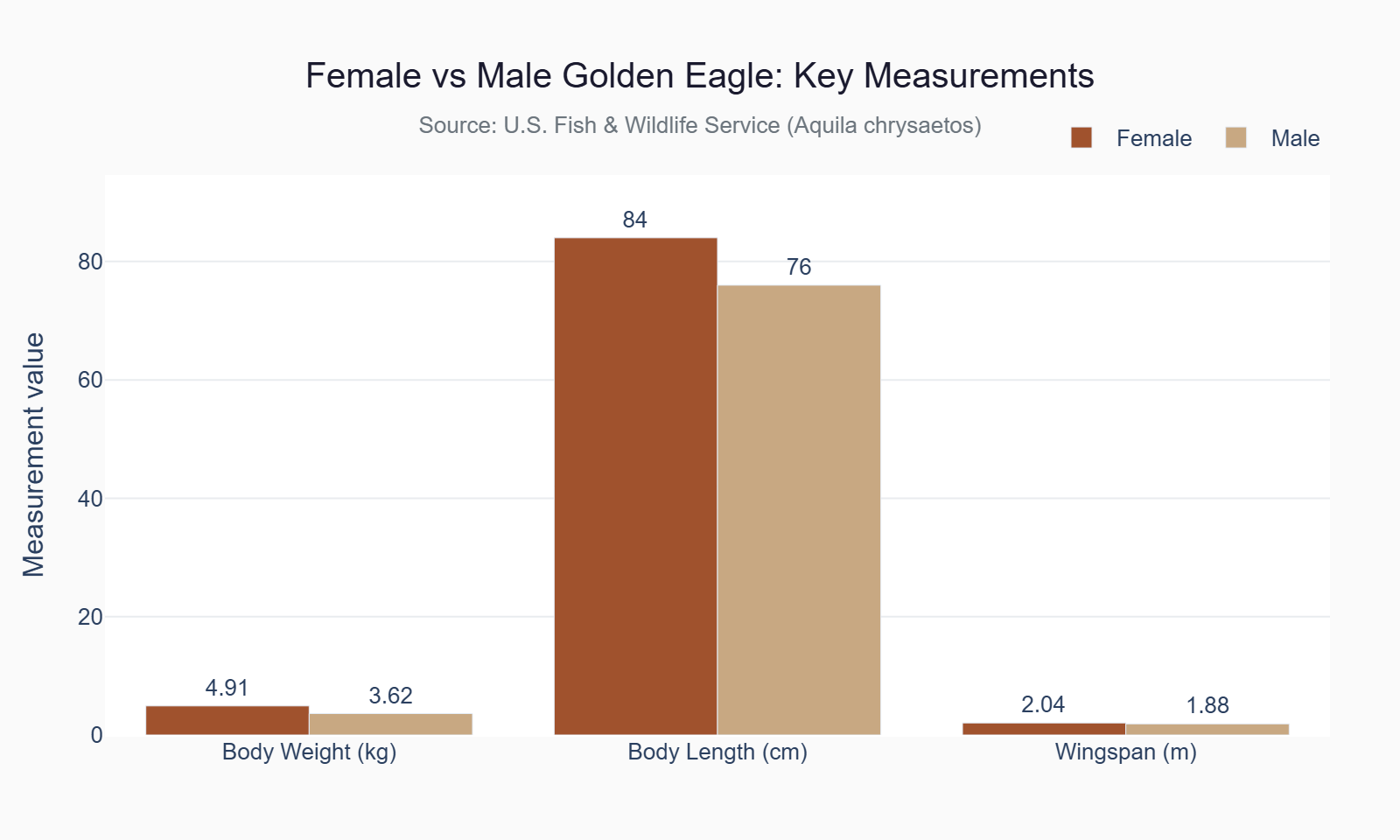
Hunters exclusively use female golden eagles (Aquila chrysaetos). The reason is practical: females are substantially larger and stronger than males. A female golden eagle can weigh up to 6.4 kg (14.1 lb), with an average of 4.91 kg (10.8 lb) (U.S. Fish & Wildlife Service). Males typically weigh 2.8–4.6 kg. That size difference — roughly 25–35% heavier — translates directly into hunting power: a larger bird can take down foxes, rabbits, and occasionally wolves or young deer.
The average wingspan across both sexes is approximately 2.04 m (6 ft 8 in), with body length ranging from 66–102 cm (U.S. Fish & Wildlife Service). In a hunting dive, a golden eagle can reach speeds close to 200 mph (322 km/h) — comparable to a peregrine falcon’s stoop, though falcons typically achieve higher peak speeds in pure vertical dives (Wikipedia, Golden Eagle; PBS Nature).
{{INFOGRAPHIC: “Female vs Male Golden Eagle: Key Measurements” | grouped_bar | {“labels”: [“Body Weight (kg)”, “Body Length (cm)”, “Wingspan (m)”], “series”: [{“name”: “Female”, “values”: [4.91, 84, 2.04]}, {“name”: “Male”, “values”: [3.62, 76, 1.88]}], “color_scheme”: “earth”, “source”: “U.S. Fish & Wildlife Service / Wikipedia (Aquila chrysaetos)”, “y_axis_label”: “Measurement”}}}
| Metric | Value | Source |
|---|---|---|
| Female weight range | 3.6–6.4 kg (7.9–14.1 lb) | U.S. Fish & Wildlife Service |
| Female weight average | 4.91 kg (10.8 lb) | U.S. Fish & Wildlife Service |
| Male weight range | 2.8–4.6 kg (6.2–10.2 lb) | U.S. Fish & Wildlife Service |
| Wingspan (average, both sexes) | ~2.04 m (6 ft 8 in) | U.S. Fish & Wildlife Service |
| Body length range | 66–102 cm (26–40 in) | U.S. Fish & Wildlife Service |
| Dive speed (maximum) | ~200 mph (~322 km/h) | Wikipedia / PBS Nature |
| Cruising flight speed | 28–32 mph (45–51 km/h) | A-Z Animals |
| Maximum payload in flight | ~3.6 kg (8 lb) | Multiple raptor sources |
| Sex used in eagle hunting | Female (larger, more powerful) | Ethnographic / USFWS confirmed |
| Lifespan in the wild | Up to 30 years | USFWS |
Female eagles also tend to be more aggressive and dominant — traits that make them easier to train for hunting. Handlers (burkitshi) begin conditioning their eagle over several months before the first hunt: hooding the bird to reduce stimuli, carrying it on the arm for hours each day to build trust, and rewarding it repeatedly at the lure.
5. Bayan-Ölgii and the Kazakh Community
Bayan-Ölgii (Баян-Өлгий) is the westernmost of Mongolia’s 21 aimags (provinces), bordering Russia and China in the Altai mountain range. Its capital, Ulgii, sits at roughly 1,800 m elevation. The province is approximately 90% Kazakh in ethnic composition — the only Muslim-majority aimag in Mongolia and a place where Kazakh, not Mongolian, is the primary language of daily life (Wikipedia, Bayan-Ölgii Province; multiple ethnographic sources).
Bayan-Ölgii is located roughly 1,600 km west of Ulaanbaatar by road — a two-day drive on unpaved steppe tracks, or a 2-hour domestic flight from the capital. The province covers 45,704 km² and has a population of approximately 110,000 (NSO Mongolia, 2020 census data). Kazakhs began settling the region in the mid-19th century, fleeing Qing dynasty pressure in Xinjiang; by 1940, the province was formally established as a Kazakh-majority aimag.
| Metric | Value | Source |
|---|---|---|
| Aimag (province) | Bayan-Ölgii | NSO Mongolia |
| Kazakh share of population | ~88–90% | Wikipedia / Multiple ethnographic sources |
| Province population | ~110,000 | NSO Mongolia (2020 census) |
| Capital city | Ulgii (Ölgii) | NSO Mongolia |
| Distance from Ulaanbaatar | ~1,600 km by road | Multiple travel sources |
| Flight time from Ulaanbaatar | ~2 hours | MIAT / Hunnu Air schedule |
| Province area | 45,704 km² | NSO Mongolia |
| Border countries | Russia, China | Geographic |
| Capital elevation | ~1,800 m | Geographic data |
| Mongolia’s Kazakh share (national) | 3.8% | NSO Mongolia (2020 census) |
The contrast between the national 3.8% Kazakh share and Bayan-Ölgii’s 90% makes the province genuinely distinct from anywhere else in Mongolia. Visitors arriving in Ulgii find Arabic-script signage, mosques, Kazakh language radio, and cuisine — beshbarmak (boiled meat over flat noodles) rather than the Mongolian tsuivan — long before they see an eagle.
For more on getting to western Mongolia and timing your visit, the best time to visit Mongolia guide covers seasonal conditions across all regions including Bayan-Ölgii in October.
6. UNESCO Recognition and Cultural Preservation
On November 16, 2010, UNESCO inscribed Falconry, a living human heritage on its Representative List of the Intangible Cultural Heritage of Humanity. Mongolia was one of 11 co-nominating nations — the largest multi-national nomination in the history of the UNESCO Convention at that time (UNESCO ICH, 2010; IAF, 2010). Other co-nominators included the United Arab Emirates, Belgium, Czech Republic, France, South Korea, Qatar, Saudi Arabia, Syria, Morocco, and Spain.
The Mongolian submission specifically documented the Kazakh berkutchi tradition of Bayan-Ölgii, distinguishing it from Mongolian falconry practiced by ethnic Mongols elsewhere in the country. The Association for Eagle Hunters of Mongolia contributed formal documentation to the nomination file (UNESCO, 2010).
Since the original inscription, the list has been extended multiple times as additional countries joined. As of 2024, more than 40 countries are party to the falconry inscription — making it one of the most internationally distributed ICH elements on UNESCO’s list.
| Metric | Value | Source |
|---|---|---|
| UNESCO inscription date | November 16, 2010 | UNESCO ICH |
| List | Representative List of ICH of Humanity | UNESCO |
| Co-nominating nations (original) | 11 | UNESCO / IAF |
| Countries on falconry inscription (2024) | 40+ | UNESCO ICH extensions |
| Largest multi-national ICH nomination (at time) | Yes | UNESCO |
| Mongolian body involved | Association for Eagle Hunters of Mongolia | UNESCO nomination file |
The UNESCO recognition has had a tangible effect on the festival. International media coverage — BBC, National Geographic, Al Jazeera — increased substantially after 2010, and foreign visitor numbers at Ulgii rose through the 2010s. It also gave the Mongolian Eagle Hunters’ Association a formal institutional standing that helped secure provincial government support for the festival infrastructure.
The Mongolia Tourism Statistics page has more on how international arrivals data tracks with cultural event peaks like the Eagle Festival.
7. The Golden Eagle Festival by the Numbers — Master Reference Table
| Metric | Value | Source | Confidence |
|---|---|---|---|
| 2025 Ulgii festival dates | October 4–5 | Mongolian Eagle Hunters’ Association | Verified |
| 2025 hunters (Ulgii) | 60+ | Mongolian Eagle Hunters’ Association, 2025 | Verified |
| 2025 visitors (Ulgii) | ~700 | Press / MEHA, 2025 | Verified |
| Ulgii festival founding year | ~2000 | Wikipedia / multiple sources | Verified |
| Sagsai festival founding year | 2002 | Wikipedia | Verified |
| Sagsai hunters (September) | ~40 | Responsible Travel, 2024 | Estimate |
| Peak Ulgii hunter participation | ~80 | Nomadic Trails (estimate) | Estimate |
| Registered burkitshi (Mongolia) | ~400 | MEHA (estimate) | Estimate |
| Active practitioners range | 250–400 | Press reports 2023–2025 | Estimate |
| Female eagle huntresses | ~11 | Al Jazeera, 2023 | Estimate |
| Aisholpan festival win year | 2014 | Multiple documented sources | Verified |
| Aisholpan’s age at 2014 win | 13 | Girl Museum / Asia Society | Verified |
| *The Eagle Huntress* release year | 2016 | Sony Pictures Classics | Verified |
| Female eagle weight (average) | 4.91 kg (10.8 lb) | USFWS | Verified |
| Female eagle weight (max) | 6.4 kg (14.1 lb) | USFWS | Verified |
| Eagle wingspan (average) | ~2.04 m (6 ft 8 in) | USFWS | Verified |
| Eagle dive speed (maximum) | ~200 mph (~322 km/h) | Wikipedia / PBS Nature | Verified |
| Eagle payload capacity | ~3.6 kg (8 lb) | Raptor sources | Verified |
| Eagle wild lifespan | Up to 30 years | USFWS | Verified |
| Years hunter keeps eagle | 7–10 years | Ethnographic sources | Verified |
| Eagle sex used for hunting | Female | USFWS / ethnographic | Verified |
| Bayan-Ölgii Kazakh population share | ~88–90% | Wikipedia / ethnographic sources | Verified |
| Bayan-Ölgii total population | ~110,000 | NSO Mongolia, 2020 census | Verified |
| Distance UB to Ulgii (road) | ~1,600 km | Travel sources | Verified |
| Flight time UB to Ulgii | ~2 hours | MIAT / Hunnu Air | Verified |
| UNESCO falconry inscription year | 2010 (Nov 16) | UNESCO ICH | Verified |
| UNESCO co-nominating nations (original) | 11 | UNESCO / IAF | Verified |
| Countries on falconry ICH (2024) | 40+ | UNESCO ICH | Verified |
| Mongolia’s national Kazakh share | 3.8% | NSO Mongolia 2020 census | Verified |
| Bayan-Ölgii area | 45,704 km² | NSO / Geographic | Verified |
| Altitude of Ulgii capital | ~1,800 m | Geographic data | Verified |
| Eagle species used | *Aquila chrysaetos* (golden eagle) | USFWS / ethnographic | Verified |
Frequently Asked Questions
When is the Golden Eagle Festival 2026?
The 2026 Golden Eagle Festival in Ulgii typically falls in the first weekend of October — usually October 3–4 or 4–5, depending on the year. The Mongolian Eagle Hunters’ Association confirms exact dates in late August. The September Sagsai festival runs roughly four to six weeks earlier. Plan to arrive in Ulgii at least one day before the festival opens.
How many eagle hunters are there in Mongolia?
Approximately 400 burkitshi (eagle hunters) are registered with the Mongolian Eagle Hunters’ Association, though active practitioners across Bayan-Ölgii Province are estimated at 250–400 depending on the source and year. This figure is an estimate; no annual census of practicing hunters is publicly published.
Why do Kazakh hunters use female golden eagles?
Female golden eagles are significantly larger and more powerful than males — averaging 4.91 kg versus roughly 3.6 kg for males, and capable of reaching up to 6.4 kg. That extra mass translates into the strength needed to take down foxes, rabbits, and corsac foxes on the open steppe. Female birds are also reported to be more assertive, which makes them more effective hunting partners.
Who was the Eagle Huntress?
Aisholpan Nurgaiv is the Kazakh girl from Bayan-Ölgii Province who competed in the 2014 Golden Eagle Festival at age 13 and won first place — the first woman on record to do so. Israeli photographer Asher Svidensky’s images of her went viral, leading to the 2016 documentary The Eagle Huntress, directed by Otto Bell and narrated by Daisy Ridley. Aisholpan received the Asia Game Changer Award in 2017.
Is falconry on UNESCO’s heritage list?
Yes. UNESCO inscribed Falconry, a living human heritage on its Representative List of the Intangible Cultural Heritage of Humanity on November 16, 2010. Mongolia was one of 11 original co-nominating nations — the largest multi-national nomination in the Convention’s history at that time. As of 2024, more than 40 countries are party to the inscription.
How far is the Golden Eagle Festival from Ulaanbaatar?
Bayan-Ölgii Province is approximately 1,600 km west of Ulaanbaatar by road — a two-day overland journey on largely unpaved steppe tracks. The practical way to travel is by domestic flight from Ulaanbaatar’s Buyant-Ukhaa airport to Ulgii, a flight of roughly two hours operated by MIAT Mongolian Airlines and Hunnu Air.
Do hunters keep their eagles forever?
No. The traditional practice is to hunt with a female eagle for 7–10 years, then release her back to the wild during late summer so she can find a mate and breed before winter. Most hunters then capture a new wild eaglet to begin the training cycle again. The release is considered an important part of the ethical relationship between hunter and bird — the eagle is a partner, not property.
How many female eagle hunters are there?
Approximately 11 eagle huntresses are documented as actively practicing in Mongolia as of 2023 (Al Jazeera, 2023). This is a small but growing number — earlier figures from the 2010s cited fewer than five. The increase coincided with broader media attention following the 2016 documentary The Eagle Huntress and the documented participation of women at recent festivals.
Conclusion
The Golden Eagle Festival is one of the most data-rich cultural events in Central Asia, and most of those numbers hold up under scrutiny. Sixty-plus hunters, 700 visitors, 400 registered burkitshi, female eagles reaching 6.4 kg, 7–10-year partnerships before release, UNESCO recognition in 2010, and a province that is 90% Kazakh — these are not tourist brochure claims. They are documented figures from the Mongolian Eagle Hunters’ Association, the U.S. Fish & Wildlife Service, UNESCO, and Mongolia’s National Statistics Office.
What the numbers don’t capture is the texture of Bayan-Ölgii in early October: the embroidered chapan coats under clear Altai sky, the weight of a trained bird on your arm, the silence before a release, and the speed of the descent that follows. That part you have to see.
The Naadam Festival statistics page and Mongolia tourism statistics overview round out the data picture for travelers planning a cultural itinerary. To attend the 2026 Eagle Festival with a locally-operated group, see the available Mongolia tours or get in touch with the Atlas Mongolia Travel team directly.
Methodology and Sources
Statistics on this page are drawn from Tier 1 sources where possible: UNESCO’s ICH database, the U.S. Fish & Wildlife Service species profile for Aquila chrysaetos, the Mongolian Eagle Hunters’ Association (via press records), and Mongolia’s National Statistics Office (2020 census). Hunter head-counts and huntress counts are labeled as estimates where no formal census exists. Festival visitor figures are edition-specific and may vary year to year. Figures marked “estimate” are derived from multiple press and operator reports but are not drawn from a single authoritative source.
Written by the Atlas Mongolia Travel team — a locally operated tour company based in Ulaanbaatar.
Featured image: Photo by Fadhil Abhimantra on Unsplash

Atlas Mongolia Travel
Atlas Mongolia Travel is a locally operated tour agency based in Ulaanbaatar, Mongolia, specializing in authentic private and group tours across Mongolia.

Leave a Reply