Mongolian Wrestling (Bökh): A Traveler’s Guide to the Heart of Naadam
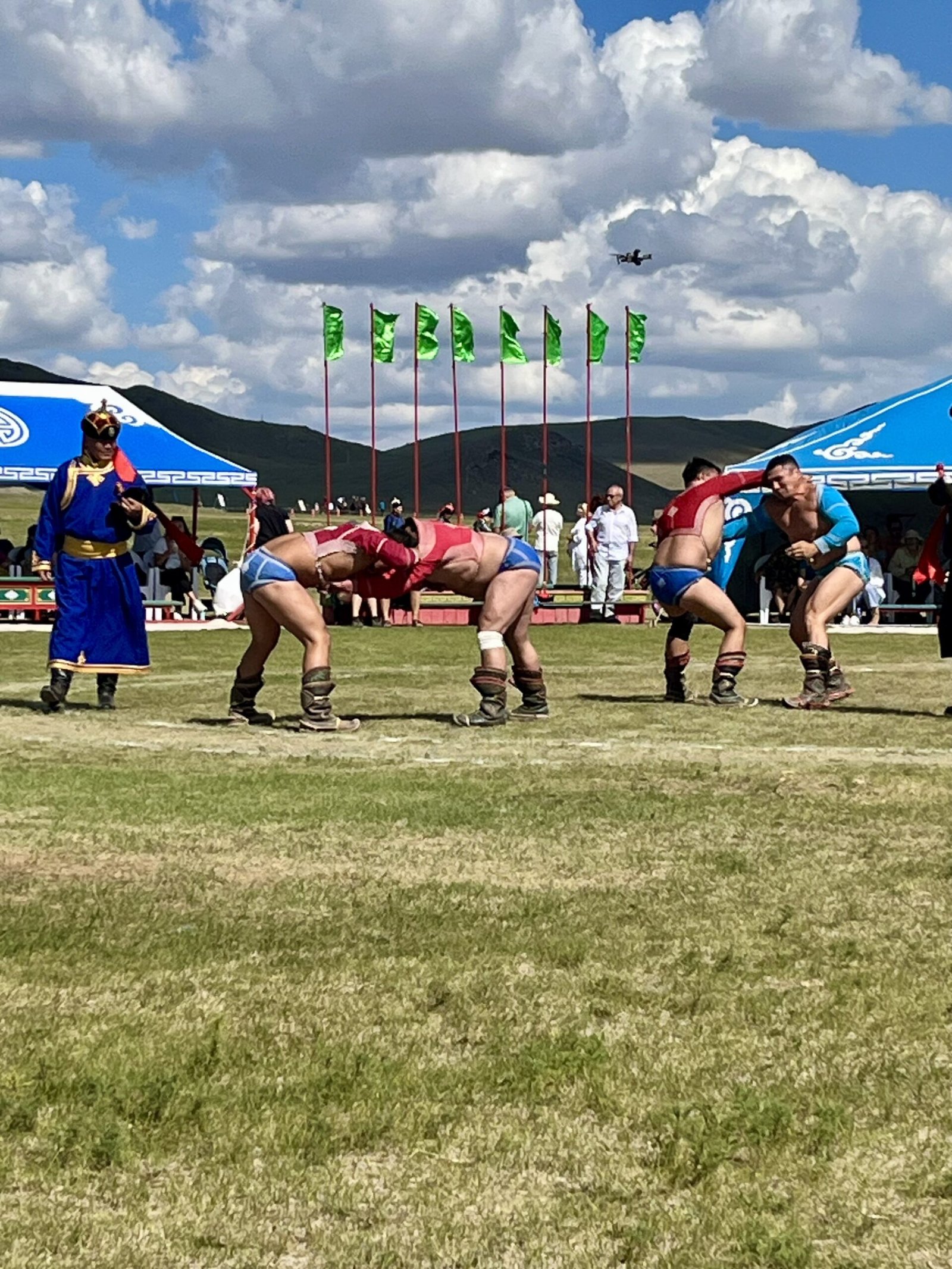
Mongolian wrestling, called bökh, is the centerpiece of the Naadam festival. It is a single-elimination contest with no weight classes and no time limit, where a wrestler loses the moment any part of his body above the knee or elbow touches the ground. Before and after each bout, wrestlers perform an eagle dance, arms spread wide like the mythic Garuda bird.
- *Bökh* is one of the “three games of men” (*eriin gurvan naadam*) alongside horse racing and archery.
- No weight classes, no clock, no ring. Touch the ground with anything above the knee or elbow and you lose.
- The national tournament in Ulaanbaatar fields 512 wrestlers across nine single-elimination rounds.
- Wrestlers earn animal titles by round (Falcon, Hawk, Elephant, Garuda, Lion), and the champion becomes a *Titan*.
- You’ll see the real thing, up close, at a small countryside (*soum*) naadam, not just the big stadium event.
What Bökh Actually Is
Strip away the costumes and the ceremony and bökh is beautifully simple. Two men face each other on open grass. There is no ring to leave, no clock to run out, no points to tally. One of them will touch the ground with something other than the soles of his feet, and the other will keep standing. That is the whole contest.
This is wrestling stripped to its oldest logic. Mongolians have practiced it for centuries, and it sits at the center of Naadam, the summer festival that brings the country to a stop every July. If you want to understand why, it helps to know that bökh is not a sport that was added to a festival. It is one of the three games of Naadam — wrestling, horse racing, and archery — the skills a nomadic horseman was once expected to carry into both daily life and war.
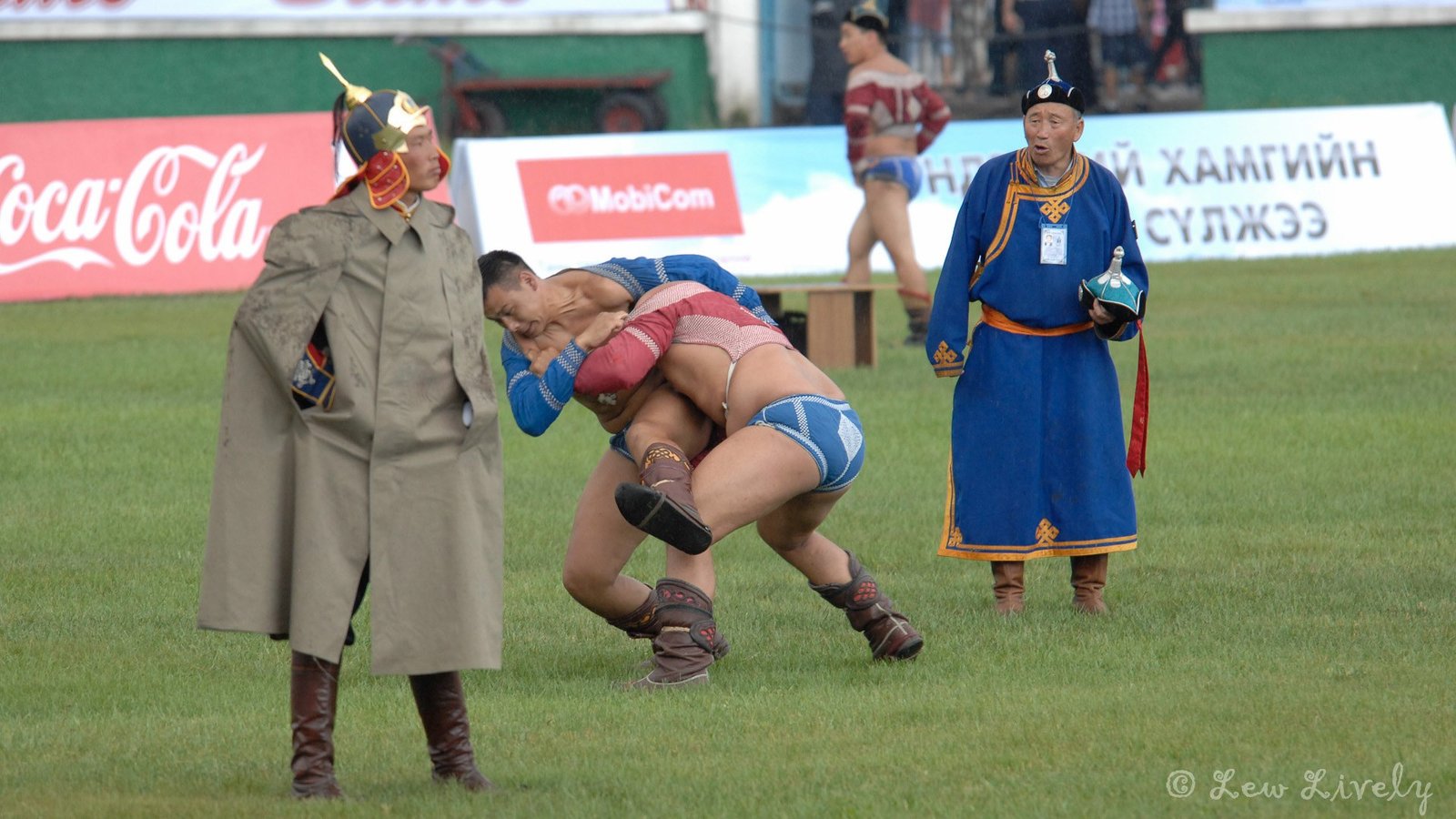
A wrestler loses if any part of his body above the knee or above the elbow touches the ground. A hand on the turf is fine. A knee on the turf ends it. There are no pins, no submissions, no judges counting points. Because the rule is so absolute, a match can end in three seconds or grind on for twenty minutes while two men lean into each other, reading grip and balance, waiting for one mistake.
No Weight Classes, No Clock, and Why
Here is the detail that surprises most visitors: there are no weight divisions. A wiry 75-kilo wrestler can be drawn against a 140-kilo giant in the opening round, and nobody adjusts the bracket to make it fair.
That is the point. Bökh grew out of a warrior culture, and on a battlefield no one checks your opponent’s weight first. The contest rewards the full package: strength, yes, but also balance, timing, and the patience to wait out a stronger man. Skill is the equalizer. A clever wrestler who knows how to break another’s balance can fold a heavier opponent who relies on muscle alone. Smaller men do win, and when they topple a giant the crowd remembers it for years.
The throws themselves are an art. Wrestlers train in mekh, the techniques of tripping, lifting, and off-balancing an opponent. There are roughly 40 core mekh, and once you count every variation and combination, experienced wrestlers speak of hundreds. A mekh might hook behind the knee, sweep a planted foot, or use an opponent’s own forward weight to send him past his base. None of it is random. A boy who grows up wrestling at countryside festivals spends years learning to feel the exact moment a man’s weight shifts onto one foot.
The Tournament: 512 Men, Nine Rounds, One Lion
The State Naadam in Ulaanbaatar runs the largest version of the contest. In a standard year, 512 wrestlers enter a single-elimination tournament that unfolds over nine rounds across two days. In special anniversary years the field can double to 1,024 wrestlers competing across ten rounds.
Single elimination means every loss is final. Win, and you advance. Lose once, anywhere in the bracket, and you are done for the year. Out of 512 men, exactly one remains standing at the end. The math is unforgiving, and it gives every round real weight — there is no group stage, no second chance, no losers’ bracket to climb back through.
Pairings in the early rounds are not blind. Senior wrestlers and reigning title-holders are often matched against lesser-known competitors first, both to honor rank and to build the drama toward the later rounds, when the remaining giants finally collide.
The Titles: Falcon, Hawk, Elephant, Garuda, Lion, Titan
Winning rounds is not just about advancing. It earns a title that a wrestler carries for the rest of his life. The titles climb a ladder of animals, each one rarer than the last.
- Falcon (Nachin): earned by winning the fifth round.
- Hawk (Khartsaga): earned by winning the sixth round.
- Elephant (Zaan): earned by winning the seventh round.
- Garuda (Garid): earned by winning the eighth round.
- Lion (Arslan): the champion of the entire tournament.
- Titan / Giant (Avarga): a Lion who wins the national tournament more than once.
The Hawk and Garuda ranks were added by Mongolia’s parliament in 2003, formalizing a system that had grown over generations. Once won, a title is yours for life. A man crowned Lion at twenty-five is still addressed as a Lion at seventy.
The very top of the ladder belongs to the Avarga, the Titan. Win the national Naadam repeatedly and the title swells with honorifics, phrases that translate roughly to “Invincible Titan.” For the rarest champions, longer praise-names stack one on the next, like “Eye-Pleasing Nationally Famous Mighty and Invincible Giant.” These are not casual nicknames. They are formal titles announced to the crowd and remembered across a wrestler’s whole career.
The contest is overseen today by the Mongolian Wrestling Federation, founded in 1961, which keeps the records, the rankings, and the traditions that make a title mean something.
The Eagle Dance and the Zasuul
Before a single grip is taken, a wrestler dances. It is called the devekh, the eagle dance, and it is one of the most recognizable sights of Naadam.
He spreads his arms wide and circles, imitating the Garuda, the mighty bird of Mongolian and Buddhist tradition, king of all birds. The movement is part warm-up, part prayer, part declaration. Wrestlers perform it both before and after every bout, circling the central flag or the state emblem on their way to and from the field. The symbolism runs deep: the wrestler casts himself as a creature of strength and flight, honoring the contest and the men watching it before he ever touches his opponent.
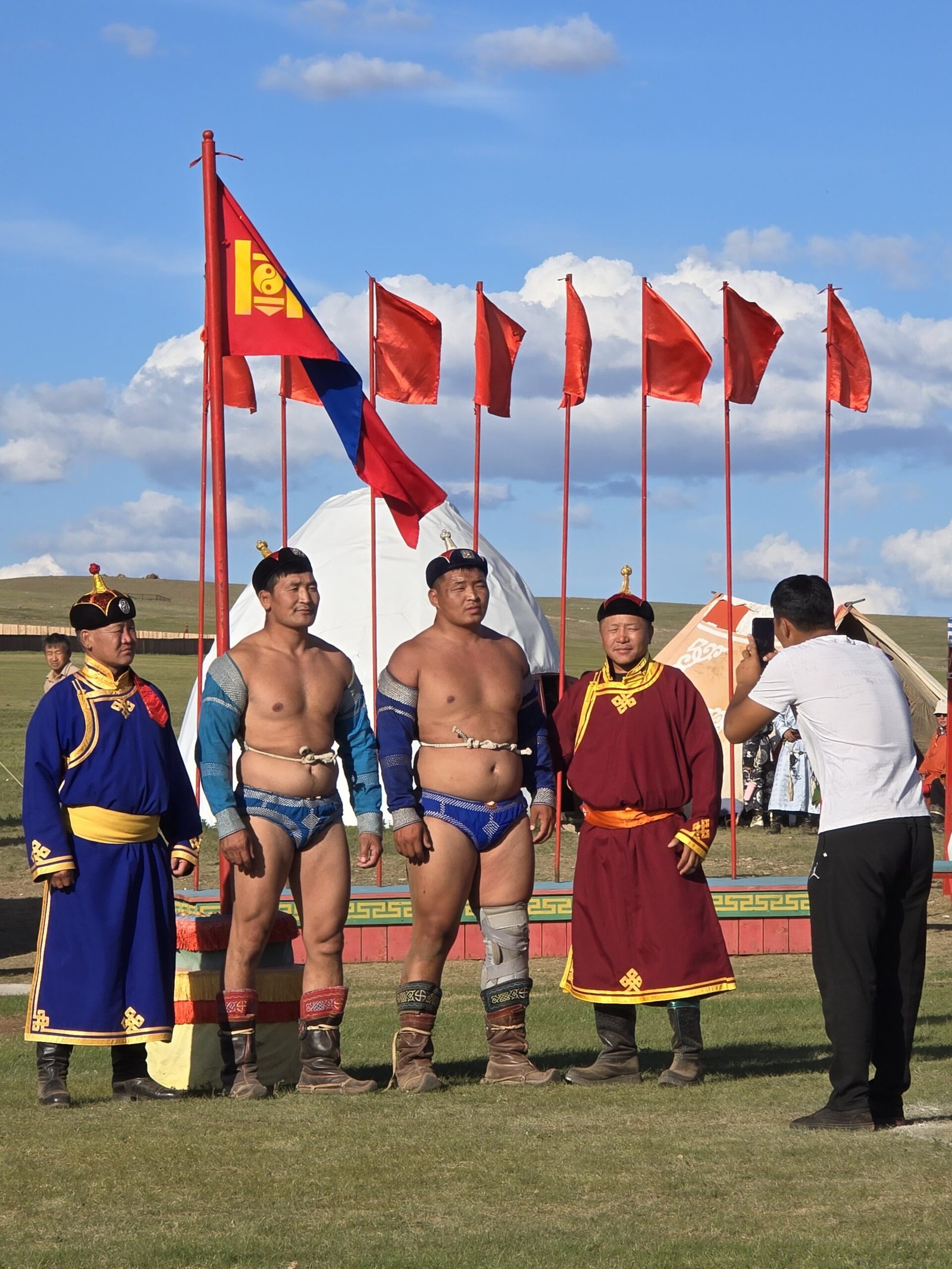
Each wrestler also has a zasuul, his attendant and second. The zasuul is no quiet helper. He chants the wrestler’s titles to the crowd, announces his lineage of victories, and fires him up by slapping his thighs and back as the bout approaches. He holds the wrestler’s hat during the match and, after key rounds, sings a song of praise for the winner. Watching a great zasuul work the crowd is half the theater of Naadam. He is the voice that turns a strong man into a hero the crowd can chant for.
The Costume, and the Tale Behind the Open Chest
The wrestling outfit is unmistakable. A wrestler wears the zodog, a tight, open-fronted jacket that bares the chest; the shuudag, a small pair of briefs; and gutal, the upturned traditional Mongolian leather boots. He arrives wearing a pointed traditional hat, which he hands to his zasuul before the eagle dance begins.
There is a tale told about that open chest. As the story goes, a woman once entered the wrestling disguised as a man and won the tournament, humiliating the men she beat. Afterward, the zodog was cut open at the front so that everyone could see, plainly, that each wrestler is a man. We pass this along the way it’s passed to us, as a told tale rather than settled history. True or not, it’s the story Mongolians tell, and it has shaped the costume you’ll see on the field.
State Naadam vs. a Countryside Naadam
The Ulaanbaatar Naadam is the grand version: 512 wrestlers, a packed stadium, national champions, television cameras. It’s a spectacle, and it’s worth seeing once. But the wrestling can feel distant from the high stands, and the crowds are large.
Out in the countryside, every district holds its own soum naadam. These are smaller and far more intimate. The field might hold 32 or 64 wrestlers instead of 512, and the bracket awards local titles. The proudest of these is the soum Elephant, the man who wins his district. You’ll stand a few meters from the grass. You’ll see families spread blankets, children sprinting between events, and the zasuul shouting himself hoarse for a neighbor he’s known his whole life. This is the version we love most, and the one that tells you the most about how Mongolians actually live. Many countryside naadams pair naturally with a stay in a herding family’s ger, where the same hospitality you’ll read about in our guide to ger etiquette in Mongolia carries over to the festival field.
One honest word of warning, told to us by an old wrestler with a grin: if you, the visiting tourist, decide to step onto the field and try your luck, expect to be folded in half before the first round is over. These men have wrestled since they could walk. Cheer loudly, eat the khuushuur, and leave the grappling to them.
Frequently Asked Questions
What is Mongolian wrestling called?
Mongolian wrestling is called bökh. It is the most important of the three games of Naadam and one of the oldest continuously practiced wrestling traditions in the world.
How do you win a Mongolian wrestling match?
You win when your opponent touches the ground with any part of his body above the knee or elbow. There are no points, no pins, and no time limit. Hands and feet touching the ground are allowed; a knee, back, or shoulder on the turf ends the bout.
Are there weight classes in Mongolian wrestling?
No. There are no weight, age, or height divisions. Any wrestler can be drawn against any other, which makes technique and balance as decisive as raw size.
What do the animal titles mean?
Titles are earned by winning successive rounds at Naadam: Falcon (fifth round), Hawk (sixth), Elephant (seventh), Garuda (eighth), and Lion (the tournament champion). A Lion who wins the national tournament more than once becomes a Titan, or Avarga. Titles are held for life.
Why do the wrestlers do an eagle dance?
The dance is called the devekh. The wrestler imitates the Garuda, the king of birds, spreading his arms like wings as a sign of strength and respect. He performs it before and after every bout, circling the flag or state emblem.
Can tourists watch Mongolian wrestling?
Yes. The biggest tournament is at the State Naadam in Ulaanbaatar each July, but the most rewarding experience is often a small countryside soum naadam, where you can stand at the edge of the field. See our guide to Naadam 2026 dates and how to attend to plan your timing.
See It for Yourself
Reading about bökh is one thing. Standing in the grass while a zasuul chants a wrestler’s titles into the wind, watching two men in zodog jackets read each other’s balance, is something else entirely. If you’d like to be there for a countryside naadam — the small, close, real version — our team can build it into a summer itinerary and find you a seat on the grass where the action actually happens. Reach out whenever you’re ready to start planning.
By Atlas Mongolia Travel
Cultural background in this article draws in part on Ts. Oyungerel’s book “Монголоо таниулъя” (“Let Me Introduce Mongolia”) and our team’s own experience at Naadam.

Atlas Mongolia Travel
Atlas Mongolia Travel is a locally operated tour agency based in Ulaanbaatar, Mongolia, specializing in authentic private and group tours across Mongolia.
Leave a Reply